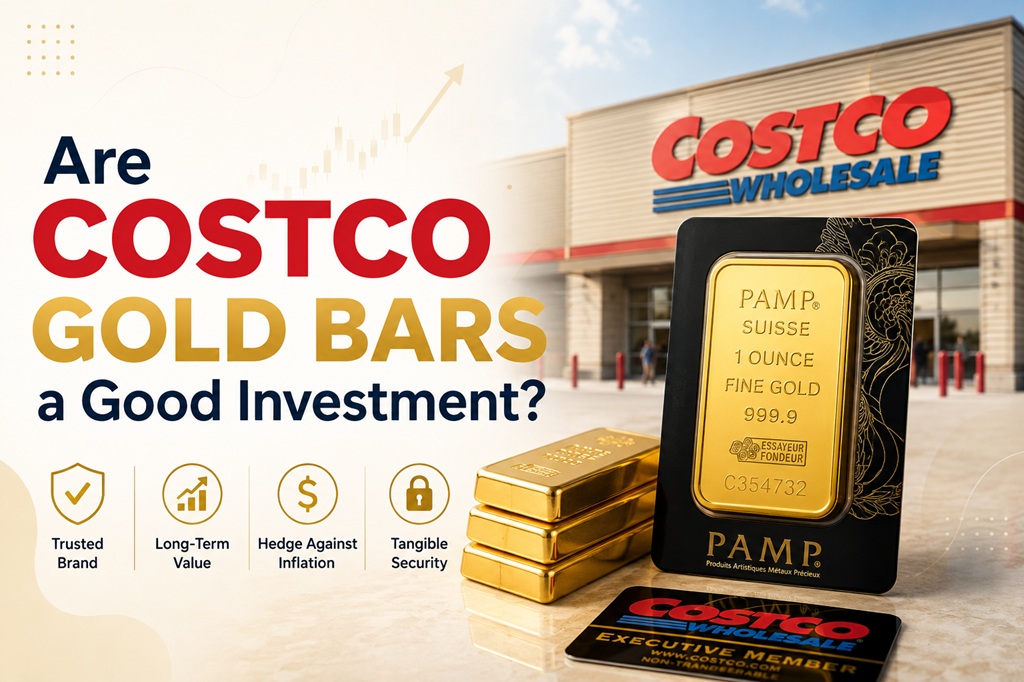
Are Costco Gold Bars a Good Investment?
TL;DR: Costco sells 1 troy ounce, 24 karat gold bars from two named refiners, PAMP Suisse and Rand Refinery, at roughly 2 percent over the spot price, a premium well below what most single-ounce gold coins carry. The catch sits on the other side of the trade. Costco treats precious metals as a final sale with no refunds and no price adjustments, purchases are capped and limited to members, and Costco does not buy the bars back, so a seller has to find a third party dealer that typically pays below spot. The low entry premium is real. So is the risk of a round trip loss if a buyer needs to sell before spot has moved enough to cover both gaps.
Are Costco gold bars a good investment: the short answer
Costco’s 1 oz gold bars sell at a premium close to the low end of the retail bullion market, which is the real draw, but the no refund policy and the lack of a Costco buyback program mean the investment case rests entirely on reselling to a third party dealer.
A gold bar bought at Costco is the same underlying asset as a gold bar bought from a specialty bullion dealer. What differs is the retail wrapper around it. Costco’s entry price is competitive because the retailer runs the product at thin margins to move volume, and a Wells Fargo analyst who follows Costco’s gold sales, Edward Kelly, described the line as “a very low profit business at best” in comments reported by CNBC in April 2024. That thin margin is what makes the entry price attractive to a buyer. It does not change the fact that Costco is a warehouse retailer, not a bullion dealer built around buybacks, redemptions, or resale infrastructure, and the product should be evaluated on that basis rather than as a substitute for a dedicated bullion or IRA channel.
What Costco actually sells
Costco sells 1 troy ounce, 24 karat gold bars refined to .9999 fine by two named refiners, PAMP Suisse and Rand Refinery, each shipped with its own certificate of authenticity, not a generic or unbranded product.
The PAMP Suisse bars carry rotating designs, including the Lady Fortuna Veriscan motif along with Lady of Liberty, Lady of Justice, West Coast Kayaker, and Diwali Lakshmi releases, and ship in CertiPAMP assay packaging with an official assay certificate and a QR code digital certificate, according to Costco’s own product listing and reporting from CBS News. The Rand Refinery bars, produced by the South African refiner and stamped with its elephant design, carry their own serial numbers instead of the PAMP assay packaging. Costco began selling the bars in September 2023. Then-CFO Richard Galanti said on an earnings call that the bars typically sell out within hours of being loaded onto the site, with a limit of two per member at the time, a comment reported by NBC News. Costco disclosed it had sold over $100 million of gold during fiscal Q1 2024, the 12 weeks ended November 26, 2023, according to Galanti’s remarks as reported by trade outlet JCK.
How the price compares to spot
Costco’s gold bars have sold for roughly 2 percent over the spot price, which sits at the high end of the generic-bar range but well below what a single-ounce sovereign coin carries, and members can trim the effective cost further through card and membership rewards.
CNBC reported in April 2024 that the bars “generally sell for about 2 percent above the spot price,” and the same reporting noted that Executive members can layer on a 2 percent membership reward, plus an additional 2 percent when paying with the Costco Citi card, on top of that base premium. For context on where that sits relative to the wider bullion market, JM Bullion’s own educational pricing guide states that “the average premium is 1 to 2 percent for gold bullion” on generic bars, with single ounce sovereign coins running higher at roughly 3 to 8 percent and silver premiums running far higher still, according to JM Bullion. Costco’s roughly 2 percent premium sits at or near the top of that generic bar range rather than meaningfully below it, but it remains well under what a buyer pays for a single ounce sovereign coin from most dealers. Wells Fargo’s Edward Kelly estimated in April 2024 that Costco’s gold sales may have been running at $100 million to $200 million a month, a volume that reflects genuine demand for that entry price rather than a promotional loss leader meant to draw foot traffic alone.
Purchase limits and who can buy
Buying a Costco gold bar requires an active Costco membership, and the retailer caps how much any one member or household can buy in a day, a structural limit that keeps the low premium product from becoming a bulk buying vehicle.
Costco’s product listings state a limit of one transaction per membership with a maximum of two units per 24 hours, though some product pages and CNBC’s own reporting describe a maximum of four units per 24 hours, an inconsistency the pack does not reconcile. A same address cap of eight units per day also applies across a household. A buyer must hold a Costco membership to purchase at all, and delivery may require an adult signature or identification confirming the recipient is 21 or older. A buyer cannot simply stock up in unlimited quantity, and anyone comparing Costco to a bulk bullion dealer should weigh that ceiling.
The return policy: no refunds on precious metals
Costco treats precious metals as a final sale, refusing both refunds and price adjustments once a gold bar leaves the warehouse or ships, a policy that puts the entire downside risk of a falling gold price on the buyer.
Costco’s official return policy page states plainly that “precious metals are non-refundable,” a line that appears on the general policy page and is reinforced on every individual gold bar product listing, according to Costco’s customer service site. Most Costco merchandise carries the retailer’s famously generous return window, but precious metals are carved out of that policy entirely, and the bars are also excluded from Costco’s price adjustment guarantee, so a buyer who sees the price drop the following week has no recourse through Costco itself. That exclusion is standard practice across the bullion industry, where dealers generally treat metal purchases as final once shipped, but it is worth stating plainly for a Costco shopper used to the retailer’s ordinary return culture. Anyone buying should treat the purchase as final from the moment it ships.
Reselling a Costco gold bar
Costco does not buy gold bars back, so anyone who wants cash must sell to an outside dealer at a discount below spot, a gap that can turn the initial 2 percent premium into a real round trip loss.
CNBC reported in September 2025 that Costco does not offer any buyback program, and that a seller “can expect about 5 percent to 10 percent less from most dealers” when trying to sell a Costco bar back into the market. The same reporting cited a survey the Wall Street Journal conducted of shops in New York City in April 2025, which found dealers there “typically offered 1 percent to 5 percent below the spot price.” Most buyers who take in a bar of this kind melt it down for refining rather than reselling it intact, so the original Costco packaging and assay certificate do little to change the offer a dealer makes. Put the two sides of the trade together and the arithmetic is straightforward: a buyer who pays roughly 2 percent over spot and later sells at 1 to 10 percent under spot is absorbing a combined gap of 3 to 12 percentage points, which spot price appreciation has to outrun before the trade is profitable. That is not a reason to avoid the product outright, but it is the single most important number missing from most casual coverage of Costco’s gold bars, and it belongs in any honest accounting of the purchase.
Does a Costco gold bar work in a gold IRA?
A Costco gold bar meets the federal fineness standard for a self directed IRA on paper, but buying it at retail with take home delivery does not satisfy the custodian and depository rules an actual gold IRA requires.
Under IRC section 408(m), gold held inside a self-directed IRA must meet a statutory fineness of .995 or higher, and a Costco bar’s .9999 fineness clears that bar with room to spare. The same statute requires that IRA-held bullion sit with an approved custodian and depository rather than in the account holder’s physical possession, which is exactly the opposite of how a Costco purchase works. A buyer picks the bar up or has it shipped directly, takes personal title and possession, and nothing about that transaction routes the metal through a custodian or a depository. Fineness alone does not make a product IRA-ready. Someone specifically shopping for a gold IRA needs a custodial provider built around that structure, not a retail purchase intended for personal possession, and this article is not a comparison of those providers.
Who this fits and who should look elsewhere
Costco gold bars fit a buyer who wants a small, low premium way to hold physical gold and is comfortable treating the purchase as a long term holding, not a trade, and they do not fit anyone who might need to sell quickly or wants a guaranteed buyback.
The case for buying rests almost entirely on the entry price. A roughly 2 percent premium from a named refiner, with a legitimate assay certificate attached, compares well against many single ounce coin premiums and gives a buyer a recognizable, high purity product without shopping around a dealer network. The case against buying rests on everything that happens after the purchase. The no refund and no price adjustment policy removes any Costco-side recourse if the price falls, the purchase limits mean this is not a channel for accumulating quantity quickly, and the absence of a Costco buyback means every exit runs through a third party dealer at a below-spot price. A buyer who treats the bar as a long horizon holding, sized modestly and held through a full market cycle, is using the product the way its economics support. A buyer who wants quick liquidity, a guaranteed exit price, or a channel that supplies larger quantities on demand is better served by a dedicated bullion dealer built around exactly those features. Always weigh a purchase like this against your own plan, and consult your own financial and tax professionals before acting on it.
FAQ
Are Costco gold bars a good investment? They can be a reasonable way to hold a small amount of physical gold at a competitive entry premium, roughly 2 percent over spot, but the no-refund policy, purchase limits, and lack of a Costco buyback mean the product suits a long horizon holder better than someone who may need to sell quickly.
What brands of gold bars does Costco sell? Costco sells 1 troy ounce, 24 karat, .9999 fine gold bars from two named refiners: PAMP Suisse, in several rotating designs, and Rand Refinery of South Africa.
How much over spot price does Costco charge for gold bars? Costco’s gold bars have sold for roughly 2 percent above the spot price, according to CNBC reporting, a premium well below what most single-ounce gold coins carry, though at the higher end of the range for generic bars.
Can you return a Costco gold bar? No. Costco’s official return policy states that precious metals are non-refundable and are not eligible for price adjustments, an exclusion from the retailer’s normal return policy.
Does Costco buy gold bars back? No. Costco has no buyback program. A seller has to find a third party dealer, and reporting from CNBC and the Wall Street Journal has found dealers typically pay somewhere between 1 percent and 10 percent below spot for a resold bar, depending on the dealer.
Can a Costco gold bar go into a gold IRA? Its .9999 fineness clears the .995 statutory minimum under IRC section 408(m), but a retail purchase with personal delivery does not meet the separate requirement that IRA-held bullion sit with an approved custodian and depository, so a Costco purchase on its own does not satisfy IRA rules.
This article is independent editorial content about a retail product and does not constitute financial, tax, or legal advice. It is not affiliated with or endorsed by Costco Wholesale Corporation.