
Is There a Mutual Fund for Gold? Your Options, Explained
TL;DR: Yes, gold mutual funds exist, but most of them do not hold gold at all. They hold shares of gold mining companies, priced once a day, with expense ratios that run from roughly 0.64 percent to more than 1 percent and sometimes a sales load on top. Physically backed gold ETFs like SPDR Gold Shares and iShares Gold Trust hold actual bullion at a lower cost and trade all day like a stock. Physical bullion carries no expense ratio at all but comes with dealer premiums and storage costs instead. All three routes are worth understanding on their own terms before choosing one.
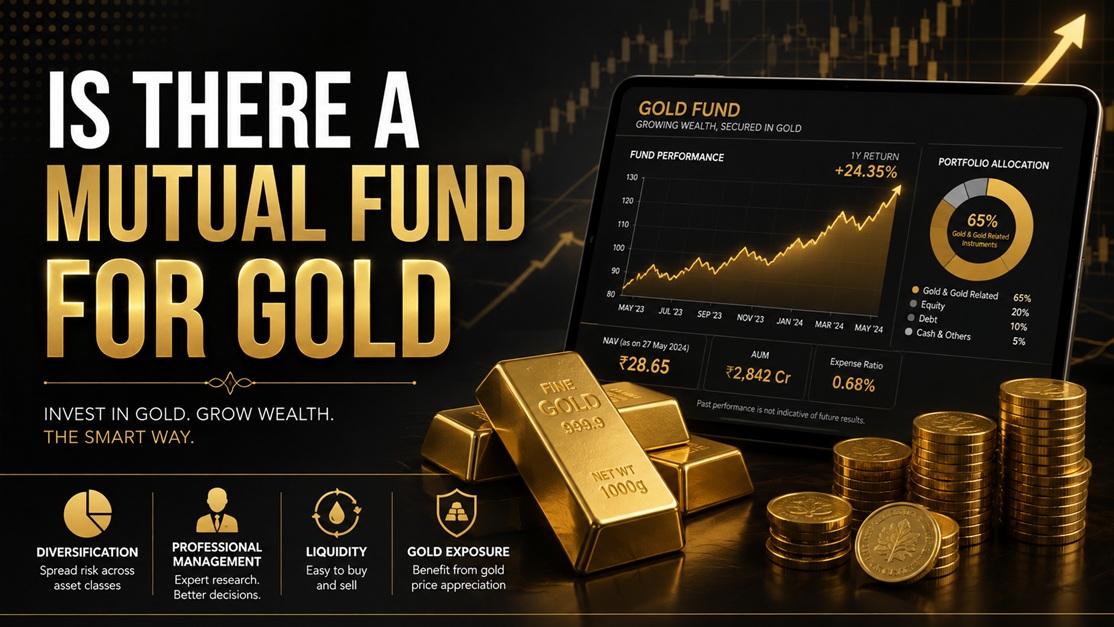
Yes, gold mutual funds exist, but most of them do not hold gold
Gold mutual funds are real and widely sold, but the name is misleading. The large majority hold shares of gold mining companies rather than bullion, which means an investor buying a gold mutual fund is usually buying mining-industry risk layered on top of the gold price, not a direct claim on metal.
The category splits into two very different buckets. The first, and by far the larger, is actively managed mining and equity funds. These are Registered Investment Companies that invest primarily in the stocks of companies that mine, refine, or explore for gold, and they are taxed like any other stock fund, not like a metal holding. The second bucket, funds that hold physical bullion directly, is rare in the United States as a true open-end mutual fund. Where physically backed gold exposure exists, it almost always takes the form of an exchange-traded fund or a closed-end trust instead of a conventional mutual fund you buy through a brokerage account at end-of-day net asset value.
That distinction matters more than the label on the fund. A reader searching for “a mutual fund for gold” is often really asking how to get price exposure to the metal itself. The honest answer is that a fund built for that purpose almost always turns out to be an ETF, not a mutual fund, and the fund that is a mutual fund almost always turns out to hold mining stocks rather than gold.
What gold mutual funds actually invest in, and what they cost
The named gold mutual funds on the market are mining and precious-metals equity funds with expense ratios well above what a bullion ETF charges, and several also carry sales loads that add a one-time cost on top of the annual fee.
Fidelity Select Gold Portfolio (FSAGX) invests at least 80 percent of its assets in gold-related securities, seeks capital appreciation, and carries a 0.64 percent expense ratio, according to its summary prospectus. It has existed since December 1985 and requires a $2,500 minimum initial investment.
Franklin Gold and Precious Metals Fund, Class A (FKRCX), invests at least 80 percent of net assets in gold and precious-metals operating companies, most of them outside the United States, and carries a 0.87 percent expense ratio.
VanEck International Investors Gold Fund, Class A (INIVX), runs a strategy dating to 1956, concentrates at least 25 percent of assets in the gold-mining industry, and reported a 1.42 percent gross and net expense ratio as of April 2026. The fund’s institutional share class, INIIX, caps expenses lower, near 1.00 percent, under a contractual arrangement.
First Eagle Gold Fund, Class A (SGGDX), carries a 1.14 percent expense ratio plus a 5.00 percent front-end sales load and a 2.00 percent redemption fee, as of a filing dated May 2026. The fund dates to 1993.
Set those figures against the cheapest physically backed ETFs, discussed below, and the gap is stark. Actively managed mining funds run from roughly 0.64 percent up to 1.42 percent before any load, several times the 0.09 percent to 0.40 percent range that physically backed bullion ETFs charge. That gap is a real, ongoing drag that compounds every year the fund is held, and it exists whether or not the fund’s stock picks beat the price of gold itself.
Physically backed gold ETFs are the closest paper alternative to bullion
Physically backed gold ETFs hold actual bars in a vault and issue shares against them, which makes them the paper instrument that tracks the metal most directly, and they cost far less than a mining mutual fund to hold.
SPDR Gold Shares (GLD), sponsored by World Gold Trust Services and marketed by State Street, is structured as a grantor trust holding physical gold bars, with its net asset value based on the LBMA Gold Price. It carries a 0.40 percent expense ratio and has traded since November 2004, making it the oldest and most liquid U.S. gold ETF. iShares Gold Trust (IAU), sponsored by an affiliate of BlackRock, uses the same grantor-trust structure and the same LBMA benchmark, at a lower 0.25 percent expense ratio.
Several newer physically backed ETFs price even lower than GLD or IAU. abrdn Physical Gold Shares (SGOL) and GraniteShares Gold Trust (BAR) both carry a 0.17 percent expense ratio. Goldman Sachs Physical Gold ETF (AAAU) runs 0.18 percent. SPDR Gold MiniShares (GLDM) now charges 0.10 percent, down from the 0.18 percent fee set at its 2018 launch, putting it near the low end of the group alongside iShares Gold Trust Micro (IAUM), which charges the least of all, a 0.09 percent sponsor fee temporarily waived to 0.07 percent through June 2027.
None of these funds let an ordinary retail holder redeem shares for physical gold. Shares can only be created or redeemed in large blocks called Baskets by authorized broker-dealers, so a retail investor buys and sells shares on the exchange the way they would any stock, not by taking delivery of bars. That is the trade retail holders make for the convenience and low cost of the structure.
Owning physical bullion carries no expense ratio, but it is not free
Physical bullion has no ongoing management fee at all, but it is not a free alternative to a fund. Dealer premiums over spot price at purchase, and storage or insurance costs afterward, replace the expense ratio a fund would charge.
The U.S. Mint does not sell bullion coins directly to the public. It distributes through Authorized Purchasers, who buy at the prevailing LBMA gold price plus a premium that runs from 3 percent on one-ounce American Eagle coins up to 9 percent on one-tenth-ounce coins, with a 1,000-ounce minimum order at that wholesale level. Retail dealer premiums to the public run higher still than those wholesale figures, and fractional coins consistently cost more per ounce than full one-ounce coins.
Beyond the purchase premium, an owner of physical bullion has to store it, whether that means a home safe, a bank box, or a paid vaulting service, and insure it against loss. None of that shows up as a stated annual percentage the way a fund’s expense ratio does, but it is a real, ongoing cost. In exchange, an owner of allocated physical bullion has direct possession and no exposure to a fund sponsor, trustee, or custodian defaulting, which is the one thing no mutual fund or ETF share can offer.
The tax treatment splits along the same lines as the structure
Physically backed gold ETFs and physical bullion are taxed identically to each other as collectibles, at a maximum long-term rate of 28 percent, while mining mutual funds are taxed like ordinary stock funds, at a maximum long-term rate of 20 percent.
According to State Street’s own tax guidance for GLD, gains on a grantor trust holding bullion, and on interests in that trust, are treated the same as gains on collectibles for federal tax purposes, capped at 28 percent for gains held more than a year. Fidelity confirms the same treatment applies to physically backed commodity ETFs generally. Mining-stock ETFs and mining mutual funds, by contrast, are Registered Investment Companies holding equities, and their long-term gains are taxed at the standard capital-gains rates that top out at 20 percent, the same as any other stock fund.
That split cuts against the intuition some investors carry into this decision. A mining mutual fund charges a higher annual fee than a bullion ETF, but its gains are taxed more favorably. A bullion ETF or physical bullion costs less to hold every year, but a sale after more than a year’s holding period can be taxed at a meaningfully higher rate. Which one nets out ahead depends on the holding period, the account type, and the investor’s own tax bracket, which is a question for a tax professional, not a general rule.
One structure worth knowing about sits outside this simple two-way split. Sprott Physical Gold Trust (PHYS), a Canadian closed-end trust rather than a U.S. mutual fund or ETF, holds fully allocated London Good Delivery bullion in custody at the Royal Canadian Mint and carries a 0.39 percent management expense ratio. Unitholders can redeem for physical gold bullion monthly, in amounts equivalent to a full London Good Delivery bar. Under certain conditions, a non-corporate U.S. investor who makes a timely QEF election can have PHYS gains taxed at the standard 15 percent or 20 percent long-term rate instead of the 28 percent collectibles rate, though missing that election forfeits the benefit.
Which route fits which investor
None of these three routes is universally better than the others. The right one depends on whether the investor wants price exposure at the lowest possible cost, wants a specific view on mining-company performance, or wants gold in hand.
An investor who simply wants the price of gold to move their portfolio, with no interest in mining-company management or exploration results, is generally best served by the cheapest physically backed ETF available, since a lower expense ratio compounds in the investor’s favor every year the position is held. An investor who wants leveraged exposure to gold-mining profitability, and is willing to accept company-specific and operational risk on top of the gold price, is the more natural audience for a mining mutual fund, understanding that both the fee and the equity risk are real. An investor who wants to hold metal directly, accepts the dealer premium and storage responsibility, and wants no fund sponsor or custodian in the chain at all, is better served by physical bullion than by either type of fund.
None of this is a recommendation of a specific fund, ticker, or dealer. Always weigh the expense ratio, the tax treatment, and your own time horizon against your own plan, and consult your own financial and tax professionals before acting on it.
Frequently asked questions
Is there a mutual fund that invests directly in physical gold, not mining stocks? True open-end mutual funds that hold physical bullion directly are rare in the United States. Where direct bullion exposure exists in a fund-like structure, it typically takes the form of an exchange-traded fund, such as SPDR Gold Shares or iShares Gold Trust, or a closed-end trust like Sprott Physical Gold Trust, rather than a conventional mutual fund.
What is the real difference between a gold mutual fund and a gold ETF? A gold mutual fund is typically an actively managed pool of mining-company stocks, priced once per day at net asset value, sometimes with a sales load like First Eagle Gold Fund’s 5.00 percent front-end charge. A gold ETF trades continuously on an exchange throughout the day, and a physically backed gold ETF holds bullion directly rather than mining shares.
Are gold mutual funds taxed the same way as gold ETFs? No. Physically backed gold ETFs and physical bullion are taxed as collectibles, up to a 28 percent long-term rate. Mining mutual funds are Registered Investment Companies holding stocks, taxed at the standard long-term capital-gains rate, up to 20 percent.
What is the cheapest way to get exposure to the price of gold? Among physically backed ETFs, iShares Gold Trust Micro currently charges the lowest fee, a 0.09 percent sponsor fee temporarily waived to 0.07 percent through June 2027, followed by abrdn Physical Gold Shares and GraniteShares Gold Trust at 0.17 percent. All of these undercut both GLD’s 0.40 percent and every named mining mutual fund’s expense ratio.
This article is educational and general in nature. It is not investment, tax, or legal advice, and it does not recommend any specific fund, ticker, or provider.