
Gold ETFs vs Physical Bullion: Which Should You Own?
TL;DR: A gold ETF and a bar of physical bullion track the same metal price but are structurally different assets. ETFs such as GLD, IAU, IAUM, SGOL, BAR, GLDM, AAAU, and OUNZ hold allocated bullion inside a grantor trust and give an investor cheap, liquid exposure through an ordinary brokerage account, with issuer-quoted expense ratios running from about 0.09 percent up to 0.40 percent a year, but no possession of the metal itself for most holders. Physical bullion gives direct title to specific bars or coins and no ongoing management fee, at the cost of a dealer premium going in, storage and insurance while holding it, and a wider buy-sell spread coming out. Both routes share a tax rule many investors miss. Gains on either one, held more than a year outside a retirement account, are capped at a maximum 28 percent federal collectibles rate rather than the lower long-term capital gains rates that apply to stocks and most other assets.
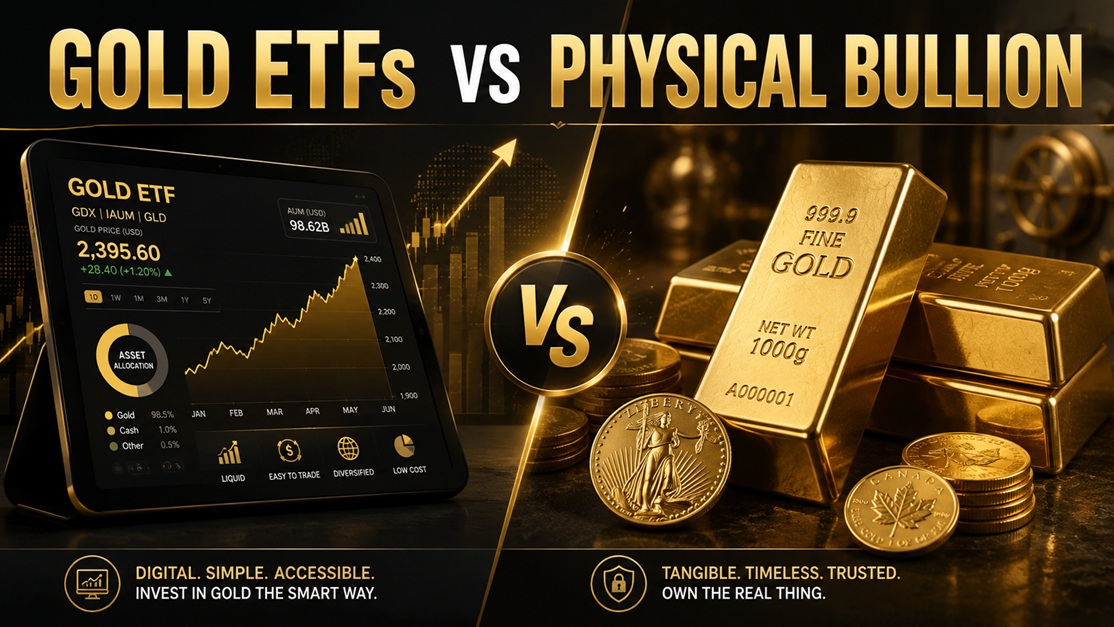
An investor comparing a gold ETF against physical bullion is choosing between two different claims on the same underlying metal. One is a share in a trust that holds allocated bars in a vault. The other is title to a specific bar or coin. Both track the spot price of gold as an asset class, but they diverge on cost structure, custody, and tax treatment. This page works through each difference using the terms issuers and regulators publish, so the choice can be matched to the reason for owning gold in the first place.
What a Gold ETF Actually Owns
A U.S. gold ETF is a grantor trust holding allocated bullion in a vault, and buying a share gives an investor price exposure to that gold without a legal claim on any specific bar.
Every major U.S. physically-backed gold ETF is structured this way, valuing its holdings against the London Bullion Market Association‘s twice-daily benchmark, the LBMA Gold Price PM. Shares are not redeemable in the way a mutual fund is. New shares are created and existing ones retired only in large blocks called Baskets, handled exclusively by registered broker-dealers known as Authorized Participants, who deposit or receive physical gold on the trust’s behalf. A retail holder buying shares through a normal brokerage account cannot walk into the vault and ask for a bar. The exception among major U.S. products is VanEck’s Merk Gold Trust (OUNZ), built specifically to let eligible holders redeem shares for physical delivery.
The issuer-quoted annual expense ratios vary more than most investors expect for products that all hold the same commodity:
| ETF | Sponsor | Expense Ratio | Note |
| iShares Gold Trust Micro (IAUM) | BlackRock affiliate | 0.09%, temporarily waived to 0.07% through June 30, 2027 | Custodian JPMorgan Chase Bank, Baskets of 50,000 shares |
| abrdn Physical Gold Shares (SGOL) | abrdn | 0.17% | Holds only post-2012 Good Delivery bars, vaulted in Switzerland |
| GraniteShares Gold Trust (BAR) | GraniteShares | 0.17% | Custodian ICBC Standard Bank, trustee BNY Mellon |
| SPDR Gold MiniShares (GLDM) | State Street | 0.10% | Reduced from an original 0.18% at launch |
| Goldman Sachs Physical Gold ETF (AAAU) | Goldman Sachs | 0.18% | |
| iShares Gold Trust (IAU) | BlackRock affiliate | 0.25% | Formed January 21, 2005 |
| VanEck Merk Gold Trust (OUNZ) | VanEck | 0.25% | One of the few that lets eligible holders take physical delivery |
| SPDR Gold Shares (GLD) | State Street | 0.40% | Deepest liquidity and options market, custodians JPMorgan Chase Bank and HSBC Bank |
That expense ratio is not billed to the investor directly. GLD’s own disclosure explains the mechanism: the trust generates no income, and because it regularly sells a small amount of gold to cover operating costs, the amount of gold backing each share declines over time. The fee is quiet, but it compounds the longer a share is held.
What Physical Bullion Gives You That an ETF Cannot
Physical bullion held in an allocated account gives an owner direct title to specific serial-numbered bars, no ongoing expense ratio, and no exposure to a custodian’s solvency, at the cost of dealer premiums, storage, and insurance.
The distinction that matters most is allocated versus unallocated, worth understanding because the same split reappears inside ETFs, digital gold tokens, and bullion dealer accounts. An allocated account means specific bars, identified by serial number, weight, and fineness, are held on the owner’s behalf and never appear on the custodian’s own balance sheet, so if the custodian fails, allocated metal is not part of its estate. An unallocated account is a general entitlement to a quantity of metal, functioning like a bank currency account, and the holder becomes an unsecured creditor of the dealer rather than owner of specific bars. Most bullion traded on the wholesale London market actually clears on an unallocated basis, because it is the cheaper default, but it carries counterparty risk that allocated physical does not.
Wholesale bars meeting the London Bullion Market Association Good Delivery standard, the benchmark that also underpins ETF and futures settlement, weigh between 350 and 430 fine troy ounces at a minimum fineness of 995.0 parts per thousand, produced only by LBMA-accredited refiners. Retail coins and smaller bars sit below that wholesale tier, sized for individual buyers rather than institutional settlement.
Comparing the Cost: ETF Fees Against Bullion Premiums and Storage
An ETF’s cost shows up as one visible number, the annual expense ratio, while physical bullion’s cost is layered across a dealer premium paid at purchase, storage or insurance while holding it, and a wider spread when selling it back.
The U.S. Mint’s own Authorized Purchaser pricing shows how premiums scale with coin size at the wholesale level: American Eagle gold coins are priced at the LBMA PM Gold Price plus a 3 percent premium for one-ounce coins, rising to 5 percent for half-ounce, 7 percent for quarter-ounce, and 9 percent for tenth-ounce coins, on a minimum order of 1,000 ounces. Smaller coins carry a higher percentage premium because minting and distribution costs spread across less metal, and retail dealer premiums paid by an individual buyer run higher still than these wholesale figures.
That premium is a one-time cost at purchase, unlike an ETF’s expense ratio, which recurs every year the position is held. For a long horizon, the ongoing fee compounds, which is why the cheapest grantor-trust ETFs, IAUM, SGOL, and BAR, running 0.09 percent to 0.17 percent, matter more the longer the position sits. For a shorter or one-time purchase, physical bullion’s upfront premium may be the simpler cost to underwrite, provided the buyer is comfortable with storage and eventual resale.
The Tax Rule Most Investors Miss: Both Are Taxed as Collectibles
Gold ETFs and physical bullion held outside a retirement account are taxed under the same federal collectibles rule, with long-term gains capped at a maximum 28 percent rate rather than the lower rates that apply to most other long-term capital gains.
The Internal Revenue Code defines gold, along with other bullion and coins, as a collectible under 26 U.S.C. § 1(h), and the Internal Revenue Service states that net capital gains from selling collectibles are taxed at a maximum rate of 28 percent, replacing the 0, 15, or 20 percent rates that would otherwise apply to a long-term gain. That is a ceiling on the rate, not an added tax, and short-term gains remain ordinary income either way.
The part investors most often get wrong is assuming an ETF escapes this because it trades like a stock. It does not. State Street’s own tax guidance for GLD, corroborated by Fidelity, confirms that gain on the sale of a grantor-trust share is treated the same as gain on the sale of the collectible itself, to the extent it reflects appreciation in the trust’s bullion. GLD, IAU, SGOL, BAR, GLDM, AAAU, and OUNZ all carry that same 28 percent collectibles exposure as a coin in a safe. The contrast worth knowing is mining-stock ETFs, which hold shares of mining companies rather than bullion and are taxed as ordinary securities, capped at the standard 20 percent long-term rate.
None of this applies inside a retirement account. A self-directed IRA holding IRA-eligible gold is taxed on distribution as ordinary income, not under the collectibles rule, but only specific coins and bars meeting a fineness standard qualify, and the metal must sit with an approved custodian rather than at home. Readers weighing that route can see how the eligibility rules work on our gold IRA page.
Liquidity and How You Actually Buy or Sell
A gold ETF trades continuously on a stock exchange during market hours at a price tracking spot, while selling physical bullion means finding a dealer willing to buy the specific coin or bar back, typically below the price you would pay to buy the same item that day.
An ETF share can be bought or sold in seconds through any brokerage account, at a quoted price that stays close to the trust’s underlying NAV, itself pegged to the LBMA Gold Price PM. Creation and redemption of the underlying Baskets is restricted to Authorized Participants, so an ordinary holder’s only exit is a normal market sale, aside from OUNZ’s delivery feature. Physical bullion has no equivalent public order book. Its exit price is whatever a dealer quotes to buy it back, and that buy-sell spread, on top of the premium already paid at purchase, is the real cost of exiting a physical position, separate from any move in the price itself.
Which One Fits Your Goal
The right choice depends on whether the objective is low-cost, liquid price exposure inside a brokerage account or physical possession of metal with no issuer counterparty to depend on, and many investors reasonably hold some of both for different reasons.
An investor who only wants price exposure at the lowest ongoing cost is best served by the cheapest grantor-trust ETFs, IAUM, SGOL, and BAR, particularly over a multi-year horizon where the expense-ratio drag compounds. An investor who wants direct ownership, is comfortable managing storage and insurance, and values holding an asset with no counterparty is better served by allocated physical bullion, weighing government-minted coins or LBMA Good Delivery-standard bars against the premium and logistics involved. Readers deciding between coin and bar formats can compare the two on our gold bars versus gold coins page, and readers focused on the tax mechanics above can go deeper on our is gold investment tax-free page.
Gold ETFs and physical bullion are two of several routes into gold as an asset class, alongside mining stocks, mutual funds, digital gold, and futures, each with its own cost and risk profile. Our investing in gold overview walks through all of them side by side. Always weigh the choice between an ETF and physical bullion against your own time horizon and plan, and consult your own financial and tax professionals before acting on it.
Frequently Asked Questions
Are gold ETFs taxed the same as physical gold?
Yes, for the major physically-backed trusts. GLD, IAU, IAUM, SGOL, BAR, GLDM, AAAU, and OUNZ are all grantor trusts holding bullion, and gain on a share sale is treated as a collectibles gain, capped at a maximum 28 percent federal rate when held more than a year, the same rate that applies to a physical coin or bar held outside a retirement account.
Can I take physical delivery of gold from an ETF I own?
Generally no. Creation and redemption of the underlying bullion is restricted to Authorized Participants trading in large Baskets, and an ordinary retail shareholder exits through a normal market sale instead. VanEck’s Merk Gold Trust (OUNZ) is the exception among major U.S. products, built to let eligible holders redeem shares for physical gold.
Which gold ETF has the lowest expense ratio?
Among the major U.S. physically-backed trusts, iShares Gold Trust Micro (IAUM) is the cheapest, with a sponsor fee of 0.09 percent that is temporarily waived to 0.07 percent through June 30, 2027. abrdn’s SGOL and GraniteShares’ BAR follow at 0.17 percent each.
What is the difference between allocated and unallocated gold?
Allocated gold means specific, serial-numbered bars are held in your name and kept off the custodian’s own balance sheet, so you have no credit exposure to the custodian. Unallocated gold is a general claim on a pool of metal, functioning like a bank account, which makes the holder an unsecured creditor of the dealer rather than the owner of specific bars.
Is a gold ETF or physical bullion better inside an IRA?
The collectibles tax rate is irrelevant inside a retirement account, since IRA distributions are taxed as ordinary income rather than under the collectibles rule. But a self-directed IRA can only hold specific coins and bars meeting an IRS fineness standard, stored with an approved custodian, a different eligibility question than the ETF-versus-physical comparison on this page. See our gold IRA page for how that eligibility works.
Do all gold ETFs hold real physical gold?
The major U.S. trusts on this page, GLD, IAU, IAUM, SGOL, BAR, GLDM, AAAU, and OUNZ, are physically-backed grantor trusts holding allocated bullion. Not every product marketed as a gold fund works this way, and some commodity-linked products track the price synthetically through futures or swaps instead of holding metal, which is disclosed in the product’s own prospectus.
This page is for general education on gold ETFs and physical bullion and is not financial, investment, tax, or legal advice. Expense ratios, fees, and tax rules change and should be verified against the current prospectus, IRS guidance, or a licensed professional before acting.