
How to Invest in Gold Mining Stocks
TL;DR: Investing in gold mining stocks means buying shares of companies that find, develop, and produce gold, either as individual miners or through mining-focused ETFs and mutual funds, and that is a fundamentally different asset from owning the metal itself. Because a large share of a miner’s costs is relatively fixed, a given move in the gold price produces a larger, leveraged move in mining profits and share prices, in both directions, and mining shares add company, operational, and jurisdictional risk on top of the price risk gold carries on its own. The two most widely held mining ETFs are VanEck’s GDX and GDXJ, and actively managed mining mutual funds offer a third route at a higher ongoing cost. Nothing here is a specific stock recommendation, and any decision should account for an investor’s own risk tolerance and tax situation.
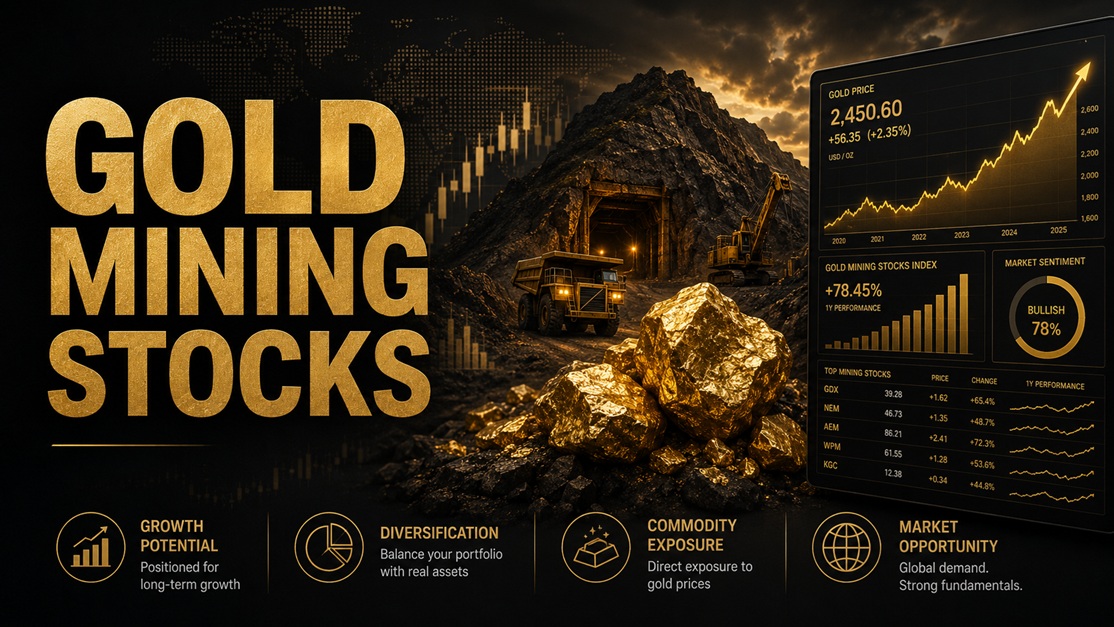
Gold mining stocks are one route among several for gold as an asset class, alongside physical bullion, physically-backed ETFs, gold IRAs, mining-focused mutual funds, digital gold, and futures. Each route carries its own cost and risk profile, and this page focuses specifically on the mining-equity route: individual miners, the main mining ETFs, and the mutual funds that hold the same kind of exposure.
How mining stocks differ from owning gold directly
Gold mining stocks track the price of gold only loosely, because an investor buying mining shares owns a company’s earnings stream rather than the metal, and share prices move on cost inflation, management decisions, and jurisdictional risk as much as on the gold price itself.
The mechanism behind that leverage is cost structure. A mining company’s all-in sustaining costs, the AISC that covers extraction, processing, and reclamation, do not move in lockstep with the gold price. When gold rises, most of a miner’s cost base stays roughly fixed, so a larger share of each additional dollar in the gold price falls straight to profit margin. When gold falls, the same fixed costs eat into margin faster than the metal price drops, and losses compound in the other direction. That is the leveraged, indirect exposure mining shares are known for. They can outperform the metal in a rising market and underperform it badly in a falling one.
Mining shares also carry risks the metal itself does not. Company-specific risk covers execution, reserve estimates, and grade quality at a given mine. Operational risk covers accidents, equipment failures, and cost overruns. Jurisdictional and political risk covers the country a mine operates in, from permitting delays to outright expropriation. Management risk covers capital-allocation decisions such as acquisitions, share issuance, and dividend policy. Hedging risk applies to producers who lock in a forward price on part of their output and can forgo the upside of a rally they hedged against. None of these risks attach to a bar of allocated gold sitting in a vault, because that bar has no balance sheet, no management team, and no mine to permit.
Individual mining stocks: what to weigh beyond the balance sheet
Buying shares in a single gold producer concentrates all of that company-specific and operational risk in one name, which is why individual mining stocks sit at the higher-risk end of the mining-equity route rather than serving as a typical starting point.
A single miner’s fortunes depend on the specific ore body it is developing, the jurisdiction it operates in, and the decisions of one management team, none of which is diversified away the way it would be inside a fund holding dozens of producers. General due-diligence factors worth understanding before evaluating any individual miner include its reported all-in sustaining costs relative to peers, the jurisdiction and permitting status of its main projects, its reserve and resource disclosures, its hedging policy, and its balance-sheet leverage. This page does not name or recommend individual mining stocks. Investors who want exposure to the sector without picking a single producer typically use a diversified vehicle instead, covered next.
Gold mining ETFs: GDX and GDXJ
The two most widely held gold mining ETFs are VanEck’s GDX and GDXJ, and the practical difference between them comes down to the size of the companies each one holds, with GDX built around larger, established producers and GDXJ built around smaller, higher-risk junior miners.
The VanEck Gold Miners ETF (GDX) carries a management fee of 0.50% and a net expense ratio of 0.51%, and VanEck has contractually capped the fund’s operating expenses from exceeding 0.53% until at least May 1, 2027. As of September 22, 2025, GDX tracks the MarketVector Global Gold Miners Index (MVGDXTR). Before that date it tracked the NYSE Arca Gold Miners Index (GDMNTR), which remains one of the two most widely cited mining benchmarks alongside the Philadelphia Gold and Silver Index, known as XAU. GDX has traded since May 16, 2006.
The VanEck Junior Gold Miners ETF (GDXJ) carries an expense ratio of 0.52% and tracks the MVIS Global Junior Gold Miners Index (MVGDXJTR), a benchmark of small-cap gold and silver miners. The fund invests at least 80% of total assets in the index’s securities, is classified non-diversified, and has traded since November 10, 2009. Recent top holdings have included Equinox Gold, Evolution Mining, Alamos Gold, Endeavour Mining, and Coeur Mining, though fund holdings change over time and this is descriptive, not a recommendation to buy any of those names.
Because GDXJ concentrates in smaller companies with thinner balance sheets and less-established operations than GDX’s larger constituents, it behaves as a higher-volatility, more leveraged play on the same underlying metal. An investor choosing between the two is effectively choosing how much company size and balance-sheet strength they want layered on top of ordinary mining-sector risk.
Gold mining mutual funds: another route to the same exposure
Actively managed gold and precious-metals mutual funds offer the same leveraged, indirect exposure as mining ETFs, professionally selected across a portfolio of producers, but at a meaningfully higher ongoing cost than a passive mining ETF.
A broader comparison of the mutual-fund route against ETFs and physical gold appears on this site’s gold mutual fund overview. The catalog below goes deeper into the specific funds in the category.
The Fidelity Select Gold Portfolio (FSAGX) carries an expense ratio of 0.64%. Its stated objective is capital appreciation, it invests at least 80% of assets in gold-related securities, and it may hold gold bullion through a wholly-owned subsidiary. It sits in Morningstar’s Equity Precious Metals category, has traded since December 1985, and carries a $2,500 minimum initial investment.
The Franklin Gold and Precious Metals Fund (Class A, FKRCX) carries an expense ratio of 0.87%. Its objective is capital appreciation with a secondary goal of current income, and it invests at least 80% of net assets in gold and precious-metals operating companies, predominantly outside the United States. The fund is non-diversified and is also available in Class C (FRGOX), Class R6 (FGPMX), and Advisor Class (FGADX).
The VanEck International Investors Gold Fund (Class A, INIVX) carries a gross and net expense ratio of 1.42% as of April 2026, with a contractual expense cap of 1.45% for Class A and 1.00% for Class I (INIIX). Its objective is long-term capital appreciation, it invests at least 80% of net assets in gold-related companies and instruments, it concentrates at least 25% of assets in the gold-mining industry, and its strategy dates back to 1956.
The First Eagle Gold Fund (Class A, SGGDX) carries an expense ratio of 1.14%, along with a 5.00% front-end sales load and a 2.00% redemption fee. It has traded since 1993 and is also available in Class C (FEGOX), Class I (FEGIX), and Class R6 (FEURX).
Other actively managed funds in this category include the Sprott Gold Equity Fund, Invesco Gold and Special Minerals Fund, and Victory Precious Metals and Minerals Fund, though this page does not quote their expense ratios because those specific figures were not independently confirmed against issuer documentation at the time of research.
Taken together, these actively managed funds run 0.64% to 1.42% in expense ratio, several multiples of what a passive bullion ETF charges, and some carry front-end sales loads on top. That fee drag has to be weighed against any expected outperformance from active management, a tradeoff worth working through with a financial professional rather than assuming either direction.
Tax treatment: mining shares versus bullion
Gold mining stocks, mining ETFs, and mining mutual funds are taxed as ordinary securities, with long-term capital gains capped at 20%, which is a meaningfully lighter tax burden than the 28% collectibles rate that applies to physically-backed gold ETFs and physical bullion held more than a year.
Physically-backed bullion ETFs such as GLD and IAU are structured as grantor trusts holding allocated gold, and State Street has confirmed in its own GLD tax materials that gains recognized by individuals from the sale of a collectible, including gold bullion, held more than one year are taxed at a maximum rate of 28% rather than the 20% rate that applies to most other long-term capital gains, with gains on a trust interest treated the same way to the extent they are attributable to the trust’s bullion. Mining stocks, mining ETFs, and mining mutual funds are structured differently, as ordinary operating companies or registered investment companies, and their gains fall under the standard securities capital-gains rules instead of the collectibles rules. This distinction is general tax information, not individualized tax advice, and the applicable rate depends on an investor’s own bracket, holding period, and account type. Always weigh this against your own plan, and consult your own financial and tax professionals before acting on it.
Where mining stocks fit in a gold allocation
Gold mining shares work best as a distinct, higher-risk position layered on top of a gold allocation rather than as a substitute for the metal itself, reserved for investors who specifically want operating leverage and can tolerate equity, operational, and jurisdictional risk in exchange for it.
An investor who wants the risk profile of gold without company or management risk is better served by allocated physical gold or a low-cost bullion ETF. An investor who specifically wants operating leverage to the gold price, and who understands that leverage cuts both ways, has mining stocks, mining ETFs, and mining mutual funds available as a distinct category. Within that category, diversified vehicles such as GDX, GDXJ, or an actively managed fund dilute the company-specific risk that concentrates in a single name. For a broader framework on sequencing gold exposure across routes, see this site’s gold investment strategies coverage.
FAQ
These questions cover the distinctions investors most often ask about when comparing gold mining stocks to owning gold directly.
Is buying GDX or GDXJ the same as owning gold? No. Both are equity funds holding shares of mining companies, not gold bullion. Their value depends on the operating performance of the companies they hold in addition to the gold price, and their returns can diverge meaningfully from the metal’s price in either direction.
What is the main difference between GDX and GDXJ? GDX holds larger, more established gold miners at a 0.51% net expense ratio and tracks the MarketVector Global Gold Miners Index. GDXJ holds smaller, higher-risk junior miners at a 0.52% expense ratio and tracks the MVIS Global Junior Gold Miners Index, and it behaves as the more volatile of the two.
How are gains on mining stocks and mining funds taxed compared to gold ETFs? Mining stocks, mining ETFs, and mining mutual funds are taxed as ordinary securities, with long-term capital gains capped at 20%. Physically-backed bullion ETFs and physical gold are taxed as collectibles, with long-term gains capped at 28%. Consult a tax professional for how this applies to your own situation.
Are actively managed gold mutual funds worth their higher fees compared to a passive mining ETF? Actively managed gold funds in this category run 0.64% to 1.42% in expense ratio, well above GDX’s 0.51% and GDXJ’s 0.52%, and some carry front-end sales loads. Whether the higher cost is worth it depends on the fund’s track record and an investor’s own conviction in active management, a judgment call this page does not make for the reader.
What risks do mining stocks carry that physical gold does not? Company-specific risk, operational risk, jurisdictional and political risk, management risk, and hedging risk. Allocated physical gold carries none of these because it is a bar of metal rather than a claim on a company’s operations.
This article is educational and informational only, not investment, tax, or legal advice. Consult a licensed financial or tax professional before making decisions about gold mining stocks, mining ETFs, or mining mutual funds.