
Physical Gold vs Paper Gold: What’s the Difference?
TL;DR: Physical gold means coins, bars, or an allocated storage account where specific bars are titled directly to the buyer, carrying no ongoing management fee but real dealer premiums and storage costs. Paper gold covers exchange-traded funds, futures contracts, mining company shares, and blockchain gold tokens, each substituting a contract or a claim on someone else’s balance sheet for direct title, which trades lower cost and more liquidity for a layer of counterparty and structural risk. Tax treatment splits along a different line than the physical-versus-paper label suggests, physically-backed bullion ETFs are taxed exactly like the metal itself.
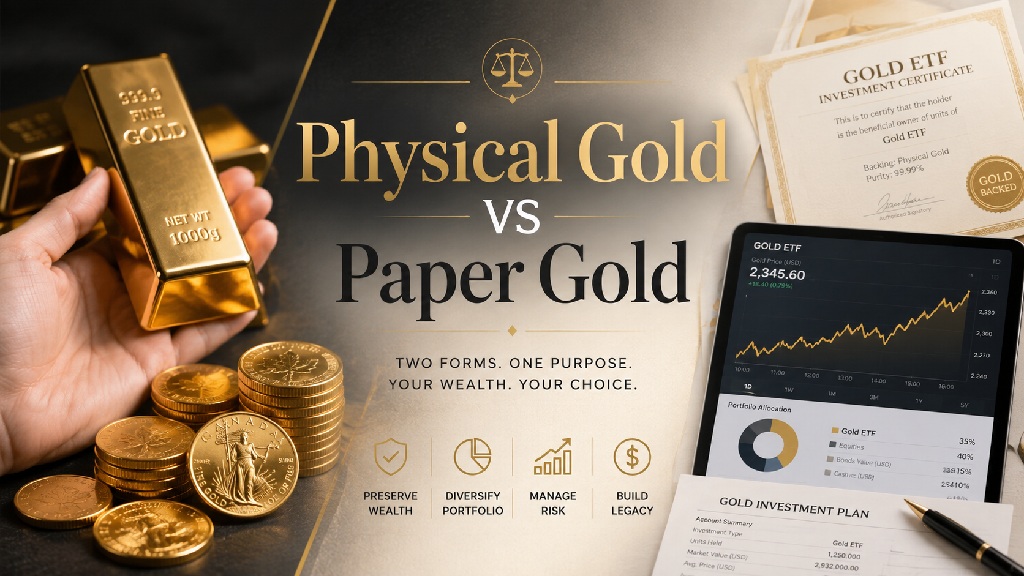
Gold as an asset class can be owned across roughly two families of instruments, and the homepage overview of investing in gold walks through every route, from bullion to a gold IRA to mining funds. This page focuses on one question inside that map: what actually changes when the metal is in your hand versus when it is represented by a contract, a share, or a token.
What Counts as Physical Gold
Physical gold means bullion coins, bullion bars, and allocated storage accounts where specific serial-numbered bars are titled directly to the buyer, the direct-ownership end of the spectrum that carries no issuer counterparty and no recurring management fee once purchased.
The U.S. Mint issues American Eagle gold bullion coins in four sizes, one ounce, one-half ounce, one-quarter ounce, and one-tenth ounce, plus the American Buffalo coin, the first .9999 fine 24-karat gold coin it has struck. The Mint does not sell directly to the public, it distributes through Authorized Purchasers, who pay the LBMA PM Gold Price plus a premium that scales with size, roughly 3 percent on one-ounce coins up to about 9 percent on tenth-ounce coins. Retail premiums to individual buyers run higher than those wholesale figures.
Bars follow a separate wholesale standard set by the London Bullion Market Association, whose Good Delivery specification requires a minimum fineness of 995 parts per thousand and a weight of 350 to 430 fine troy ounces, produced only by LBMA-accredited refiners. That standard underpins not just physical bars but the vault-grade gold behind ETFs, futures delivery, and tokenized gold alike. An allocated storage account extends the same direct-title logic without the buyer holding metal personally, specific bars are assigned and segregated from the operator’s own holdings, the arrangement gold-bars-vs-gold-coins comparisons generally assume.
What Counts as Paper Gold
Paper gold spans several distinct instruments, exchange-traded funds that hold bullion in trust, futures contracts on a regulated exchange, mining company shares, and blockchain tokens backed by vaulted metal, each substituting a contract or a pooled claim for the direct title that physical ownership provides.
Physically-backed gold ETFs are grantor trusts that hold allocated bullion and value it against the LBMA Gold Price, with expense ratios that vary by issuer and are compared below. Shares are created and redeemed only in large baskets by registered Authorized Participants, so a retail holder buys and sells shares in the secondary market rather than redeeming for metal. VanEck Merk Gold Trust (OUNZ) is a notable exception that allows eligible holders to take physical delivery.
Futures are the leveraged end of paper gold. A COMEX Gold (GC) contract, per CME Group’s own rulebook, covers 100 troy ounces, moves in minimum increments of ten cents per ounce ($10 per contract), and is deliverable as one 100-ounce bar or three one-kilo bars of at least 0.995 fineness. Futures require posting margin rather than the full contract value, positions are marked to market twice daily, and an account below maintenance margin faces a call that can force liquidation. A smaller Micro Gold contract (MGC, 10 ounces) is also listed.
Mining equities are an indirect route. Because a large share of a miner’s operating cost is fixed, a given move in the gold price produces a larger swing in mining profits, in both directions. The VanEck Gold Miners ETF (GDX) carries a 0.51 percent net expense ratio, and the smaller-cap VanEck Junior Gold Miners ETF (GDXJ) charges 0.52 percent. Owning miners adds equity-market, operational, and country risk on top of gold-price exposure, a different bet than owning the metal.
Tokenized gold is the newest paper form. Pax Gold (PAXG), issued by Paxos Trust Company, represents one fine troy ounce of a London Good Delivery bar per token, backed by gold custodied in LBMA vaults and audited monthly, with Paxos regulated as a trust company by the Office of the Comptroller of the Currency. Redeeming PAXG for physical metal requires roughly 430 tokens, one full Good Delivery bar, so small holders realistically exit through the secondary market rather than physical delivery.
Digital gold products are covered in more depth on exploring digital gold investment schemes.
Allocated vs Unallocated Is the Real Dividing Line
The distinction that decides counterparty risk is not physical versus paper, it is allocated versus unallocated, and that line cuts through both categories rather than sitting neatly between them.
The London Bullion Market Association defines an allocated account as one where the customer holds title to specific bars, identified by bar number, weight, and fineness on a weight list, with the custodian holding them on the client’s behalf. Because allocated metal is not on the custodian’s own balance sheet, the LBMA notes it cannot be used for the custodian’s own trading and, by definition, cannot be overdrawn. If the account operator fails, the holder can in principle retrieve the specific bars.
Unallocated gold works differently. The LBMA describes an unallocated account as a general entitlement to a quantity of metal rather than title to specific bars, functioning much like a bank currency account, and it is the most common way bullion clears in the wholesale London market. The holder of an unallocated position is an unsecured creditor of the institution, with a contractual claim rather than a bar to point to, which matters only when the institution runs into trouble.
That same split reappears inside paper gold. A grantor-trust ETF that holds allocated bullion in a named custodian’s vault sits closer to the safe end of the spectrum than an unallocated bullion account does, even though the ETF is unambiguously a paper instrument. What decides the risk is not the wrapper but whether the underlying claim is a specific, segregated bar or a pooled promise.
Cost: Dealer Premiums vs Expense Ratios
Physical gold carries a one-time dealer premium over spot plus ongoing storage and insurance costs and no annual management fee, while paper gold trades that structure for a recurring expense ratio or margin cost that compounds quietly over a long holding period.
On the physical side, the premium is paid once at purchase, and again as a bid-ask spread at sale, with no yearly deduction from the pile of metal itself. Storage and insurance are additional, ongoing costs whether the metal sits in a home safe or an allocated vault account.
On the paper side, physically-backed bullion ETFs charge an annual expense ratio deducted from the trust’s holdings, so the gold behind each share slowly declines over time. Among the major U.S. bullion trusts, iShares Gold Trust Micro (IAUM) quotes a 0.09 percent sponsor fee, temporarily waived to 0.07 percent through mid-2027, SPDR Gold MiniShares (GLDM) charges a 0.10 percent sponsor fee, abrdn Physical Gold Shares (SGOL) and GraniteShares Gold Trust (BAR) sit near 0.17 percent, Goldman Sachs Physical Gold ETF (AAAU) runs about 0.18 percent, iShares Gold Trust (IAU) and OUNZ charge 0.25 percent, and SPDR Gold Shares (GLD) charges 0.40 percent, the highest of the group but also the deepest and most heavily traded.
Mining ETFs run higher, around 0.51 to 0.52 percent, and actively managed gold mutual funds run higher still, from roughly 0.64 toward 1.42 percent, some carrying a front-end sales load. Futures carry no expense ratio but require ongoing margin discipline and periodic rolling, both with real costs of their own.
Liquidity and Access
Exchange-traded and futures forms of paper gold are generally the most liquid way to get price exposure, tradable throughout the market day, while physical gold’s liquidity depends heavily on which specific coin or bar is being sold.
A share of a major bullion ETF trades on an exchange like any stock, with continuous pricing during market hours, and COMEX futures likewise trade in a deep, regulated market used by hedgers and institutions as well as speculators. Physical metal is different, widely recognized government-minted coins are comparatively easy to resell at tight spreads, while generic private-mint rounds or unbranded bars can be slower to move and may require assay. Redemption for actual metal is the exception across paper products generally, OUNZ and PAXG are two exceptions, and both require meeting a minimum before delivery happens.
Tax Treatment Follows the Metal, Not the Label
Physical bullion and physically-backed grantor-trust ETFs are taxed identically, as collectibles, at a maximum federal long-term capital gains rate of 28 percent, while mining stocks, mining ETFs, and mining mutual funds are taxed as ordinary securities at the lower 20 percent maximum rate.
Under the Internal Revenue Code, a gain from a collectible held more than a year is capped at a 28 percent maximum rate rather than the lower rates that apply to most other long-term gains, and the IRS confirms net gains on collectibles such as coins are taxed at that maximum rate. That treatment extends to grantor-trust bullion ETFs. State Street’s own tax materials for SPDR Gold Shares (GLD) state that a gain on the sale of a trust interest holding collectibles is treated the same as a gain on the collectibles themselves, and Fidelity’s investor education materials describe the same treatment for other physically-backed commodity ETFs. An investor who assumes an ETF share escapes the 28 percent rate because it is “just paper” is mistaken.
Mining equities and mining funds sit outside that rule because they are securities in operating companies, not collectible bullion, so their gains are taxed at the standard 20 percent maximum rate. COMEX gold futures follow a third regime, a blended 60 percent long-term and 40 percent short-term treatment regardless of holding period. None of this applies inside a retirement account. A self-directed gold IRA follows its own rules under IRC Section 408(m), covered further on is investment in gold tax-free, and the collectibles-rate question becomes moot once the metal sits inside that structure.
Physical vs Paper at a Glance
| Attribute | Physical (allocated) | Paper (bullion ETF example) |
| What you own | Title to specific bars or coins | Shares in a trust that holds bullion |
| Ongoing cost | Storage and insurance, no management fee | Annual expense ratio, roughly 0.07 to 0.40 percent |
| Entry cost | Dealer premium over spot | Brokerage commission, if any |
| Counterparty risk | None, if genuinely allocated | Low for major grantor trusts, higher for synthetic or unallocated products |
| Redemption for metal | Direct, it is already yours | Rare, exceptions like OUNZ exist |
| Tax on long-term gain | Collectibles rate, up to 28 percent | Same collectibles rate for physically-backed trusts |
Which One Fits a Given Investor
An investor who wants a counterparty-free store of value and is willing to pay for premiums, storage, and lower divisibility should lean toward allocated physical gold, while an investor who wants the cheapest, most liquid price exposure and does not need to hold metal in hand should lean toward a low-cost bullion ETF.
The two are not mutually exclusive, many holders use both, physical for a core position meant to sit untouched, paper for the portion they trade or rebalance easily. Mining equities and futures are a different bet, one on operating leverage and market structure rather than gold itself, suited to investors who specifically want that exposure and can tolerate the added risk. Always weigh these choices against your own plan and time horizon, and consult your own financial and tax professionals before acting on them.
Frequently Asked Questions
Is paper gold safe?
It depends on the specific instrument and, within that instrument, on whether the underlying claim is allocated or unallocated. A physically-backed grantor-trust ETF holding allocated bullion in a named custodian’s vault carries limited counterparty exposure. An unallocated bullion account carries meaningfully more.
What is the difference between allocated and unallocated gold?
Allocated gold means specific, serial-numbered bars are titled to the account holder and held in custody. Unallocated gold means the holder has a general contractual claim on a pool of metal and ranks as an unsecured creditor of the institution holding it, similar to a currency account at a bank.
Can a gold ETF be converted into physical gold?
Generally not for retail holders. Most U.S. bullion ETFs create and redeem shares only in large baskets through registered Authorized Participants, so an individual investor buys and sells shares rather than metal. VanEck Merk Gold Trust (OUNZ) is a notable exception built to allow eligible holders to take delivery.
Is a gold ETF taxed the same as physical gold?
For the major physically-backed grantor-trust ETFs, yes. Both are treated as collectibles under the tax code, with long-term gains capped at a maximum 28 percent federal rate. Mining stocks, mining ETFs, and mining mutual funds are taxed at the standard 20 percent maximum long-term rate, because they are securities rather than collectible bullion.
Which is more liquid, physical gold or a gold ETF?
A major bullion ETF is generally more liquid, trading continuously on an exchange during market hours. Among physical forms, widely recognized government-minted coins are typically the easiest to resell quickly at a fair price, while generic bars or rounds can take longer to move.
This article is for educational purposes only and is not investment, tax, or legal advice. Consult a licensed financial or tax professional before making decisions about physical or paper gold.