
Platinum and Palladium IRAs, Explained
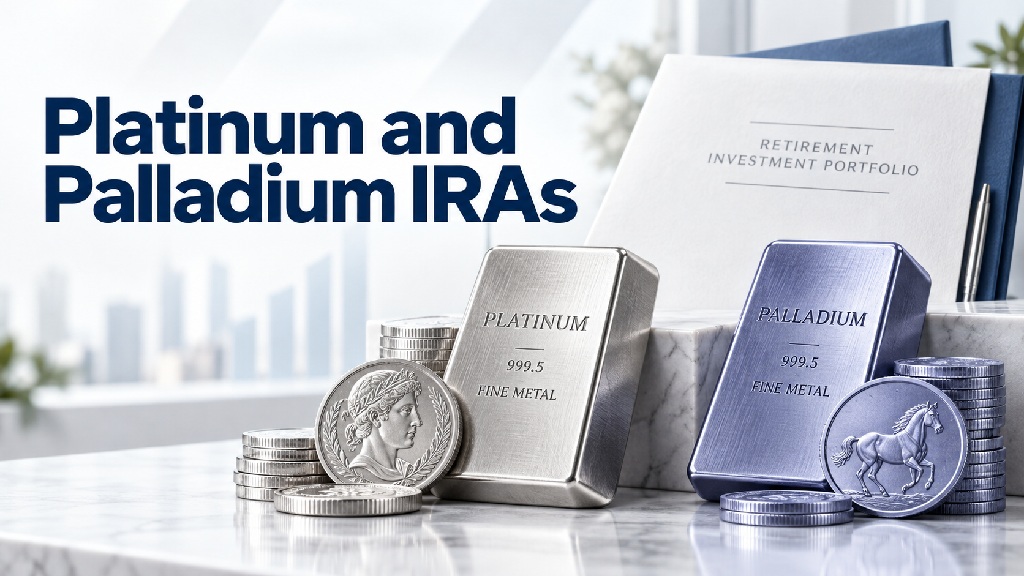
TL;DR: Both platinum and palladium bullion are IRA-eligible under IRC 408(m)(3)(B), each requiring a minimum fineness of .9995 and custody by an approved IRA trustee at a third-party depository, never by the account owner directly. Platinum has a second route into eligibility because the American Platinum Eagle is separately named in the statute, while palladium qualifies only through the fineness pathway. Approved products include the American Platinum Eagle, the Austrian Platinum Philharmonic, the American Palladium Eagle, and accredited bars in both metals. Once eligibility is established, the two metals still behave differently from gold in the market, which is a trading characteristic, not a legal one.
For a full overview of how physical metal, mining exposure, and paper instruments fit into a retirement portfolio, see investingingold.com’s guide to investing in gold.
Are platinum and palladium IRA eligible
Yes, both platinum and palladium are IRA-eligible metals under federal tax law, provided each one is purchased as a bullion coin, bar, or round meeting a minimum fineness of .9995 and is held by an IRA trustee rather than the account owner.
The starting point is the tax code’s default rule. IRC § 408(m) treats a “collectible,” including a broad category described as “any metal or gem,” as a taxable distribution the moment an IRA acquires it. Section 408(m)(3)(B) then carves out an exception for “any gold, silver, platinum, or palladium bullion of a fineness equal to or exceeding the minimum fineness that a contract market… requires for metals which may be delivered in satisfaction of a regulated futures contract,” on the condition that the bullion sits in the physical possession of an approved trustee. That contract-market minimum is set by the exchange, not the IRS. CME Group’s own COMEX and NYMEX rulebooks put the deliverable-grade floor at 99.95 percent, or .9995, for both platinum and palladium, the same figure the tax code borrows by reference. Gold’s bar is lower, at .995, and silver’s is .999, which is why platinum and palladium sit at the strictest end of the fineness scale among the four IRA-eligible metals.
Why platinum and palladium reach eligibility through different routes
Platinum and palladium both clear the .9995 fineness bar, but platinum has a second, independent path into an IRA that palladium does not, because the statute names a specific platinum coin outright.
Section 408(m)(3) actually contains two separate exceptions, not one. The first, at 408(m)(3)(A), lists specific coins by name, including a platinum coin described in 31 U.S.C. § 5112(k), and those named coins qualify regardless of exactly how they are structured. The second, at 408(m)(3)(B), is the fineness-and-custody pathway described above, open to any of the four metals. The American Platinum Eagle qualifies both ways at once, since it is named in the statute and independently meets .9995 fineness. Palladium is not mentioned anywhere in the named-coin list at 408(m)(3)(A). Every palladium product, including coins struck by a government mint, reaches an IRA only through the fineness-and-custody route at 408(m)(3)(B). The practical effect for an investor is small, since both routes land on the same outcome, an eligible metal held by a trustee. The distinction matters mainly for understanding why some marketing materials describe a “named palladium coin,” which does not exist in the statute itself.
Which platinum products qualify
The core IRA-eligible platinum lineup is narrow: the American Platinum Eagle, the Austrian Platinum Philharmonic, and accredited platinum bars, all struck or refined to at least .9995 fine.
The American Platinum Eagle, first released in 1997 by the U.S. Mint, is composed of 99.95 percent platinum, sold in a one-ounce, $100 face-value coin, and it is the product named directly in the statute. The Austrian Mint’s Platinum Philharmonic, issued since 2016 in a one-ounce, 100 euro coin, states its own fineness at 999.5, the same figure expressed differently. Platinum bars are eligible on the same fineness test, provided they come from an accredited refiner or a national mint rather than an unbranded source. The Canadian Platinum Maple Leaf is also widely described in the market at .9995 fine, though this article did not independently confirm that figure from the Royal Canadian Mint’s own product page.
Which palladium products qualify
Palladium’s approved lineup is smaller than platinum’s or gold’s, centered on the American Palladium Eagle, the Canadian Palladium Maple Leaf, and accredited palladium bars, all at .9995 fine.
The American Palladium Eagle was first released in 2017, authorized under the American Eagle Palladium Bullion Coin Act of 2010, struck to .9995 fine in a one-ounce, $25 face-value coin. Because palladium has no named-coin exception, the Palladium Eagle reaches the IRA only through the fineness-and-custody test, not through the same statutory naming that covers the Platinum and Gold Eagles. The Canadian Palladium Maple Leaf, first issued in November 2005 as the first palladium coin from a government mint, is widely reported at .9995 fine as well, though again that figure traces to market and encyclopedic sources rather than the Royal Canadian Mint’s own product page in this research.
Accredited palladium bars round out the list, eligible on the same .9995 test applied to any refiner-branded bar or round.
Custody rules work the same way as a gold IRA
Platinum and palladium IRAs follow the identical custody structure as a gold IRA: the metal has to sit with an approved trustee at a third-party depository, and the account owner is never permitted to hold it personally.
IRC § 408(a) requires the trustee to be a bank or an IRS-approved nonbank custodian, and the 408(m)(3)(B) exception that makes platinum and palladium eligible in the first place is conditioned on the bullion being “in the physical possession of a trustee,” not the investor. The U.S. Tax Court tested exactly this boundary in McNulty v. Commissioner, 157 T.C. No. 10 (2021), where an IRA owner used a self-directed IRA-owned LLC to buy American Eagle coins and stored them in a home safe. The court held that taking personal possession created a taxable distribution equal to the cost of the coins, rejecting the argument that an LLC wrapper changed the custody requirement, and it upheld accuracy-related penalties on top of the tax. The same reasoning applies with equal force to platinum and palladium, since the statutory “physical possession of a trustee” language covers all four eligible metals identically. In practice, an approved custodian designates a depository, the metal is vaulted there, and the owner directs the account without ever taking the coins or bars home. The site’s guide to home storage warnings and its walkthrough of how a precious metals IRA works end to end cover this mechanic in more depth.
How a platinum or palladium IRA differs from a gold IRA in practice
Legal eligibility is only part of the picture. As market context rather than a legal claim, platinum and especially palladium trade in thinner, more industrial-demand-driven markets than gold, which shows up as wider dealer premiums and sharper price swings.
The clearest evidence is in the futures market that the IRA fineness rule itself borrows from. Data reported by Barchart put NYMEX palladium’s total open interest at roughly 13,488 contracts against platinum’s roughly 72,885, with average daily palladium volume running below 5,000 contracts, a gap that tends to translate into wider bid-ask spreads and higher premiums over spot for retail buyers of the smaller market. Palladium’s price history illustrates the volatility side of that same story. Data cited by Chards from the London Bullion Market Association’s benchmark put palladium at a record $3,429.50 per troy ounce on March 7, 2022, coinciding with Russia’s invasion of Ukraine, before it fell to an $813.50 low by August 2024. Gold has no comparable single-industry demand base. Platinum and palladium both lean heavily on the automotive catalytic-converter market, and supply is concentrated geographically as well. The U.S. Geological Survey’s 2024 minerals data put South Africa’s share of world mined platinum production at roughly 70 percent, and industry estimates put Russia and South Africa together at roughly 80 percent of primary palladium supply. None of this changes whether the metal is IRA-eligible. It does mean an investor choosing platinum or palladium over gold inside an IRA is taking on a narrower, more cyclical market on top of the same custody and tax rules, and that trade-off is worth weighing against the reason for holding the metal in the first place. Readers comparing providers for any precious metals IRA, including one funded with platinum or palladium, can consult the site’s gold IRA guide for that side of the decision. Always weigh a metal-specific allocation against your own plan, and consult your own financial and tax professionals before acting on it.
Frequently Asked Questions
Is platinum IRA eligible
Yes. Platinum bullion meeting a minimum fineness of .9995 and held by an approved IRA trustee is eligible under IRC § 408(m)(3)(B). The American Platinum Eagle is additionally named directly in the statute at 408(m)(3)(A), so it qualifies through both routes at once.
Is palladium IRA eligible
Yes, on the same .9995 fineness test and the same trustee-custody condition under IRC § 408(m)(3)(B). Palladium is not named in the statute’s separate coin list, so every palladium product, coin or bar, reaches eligibility only through the fineness pathway.
What is the minimum fineness for platinum and palladium in an IRA
.9995, the same figure for both metals, set by the CME/COMEX and NYMEX deliverable-grade standard that IRC § 408(m)(3)(B) references. That is a stricter bar than gold’s .995 or silver’s .999.
Can platinum or palladium IRA metal be stored at home
No. The statute requires physical possession by a trustee, and the U.S. Tax Court’s McNulty v. Commissioner decision held that an IRA owner taking personal possession of eligible metal, even through an IRA-owned LLC, creates a taxable distribution plus potential penalties.
How is a platinum or palladium IRA different from a gold IRA
Legally, the custody and eligibility framework is the same. As market context, platinum and palladium trade with thinner liquidity, wider premiums, and more industrial-demand-driven volatility than gold, reflecting each metal’s smaller futures market and concentrated mine supply.
This article is educational information about IRA eligibility rules and market characteristics. It is not individualized financial, tax, or legal advice, and readers should consult a qualified financial or tax professional before opening or funding a precious metals IRA.