
IRA-Eligible Gold: Coins vs Bars vs Rounds
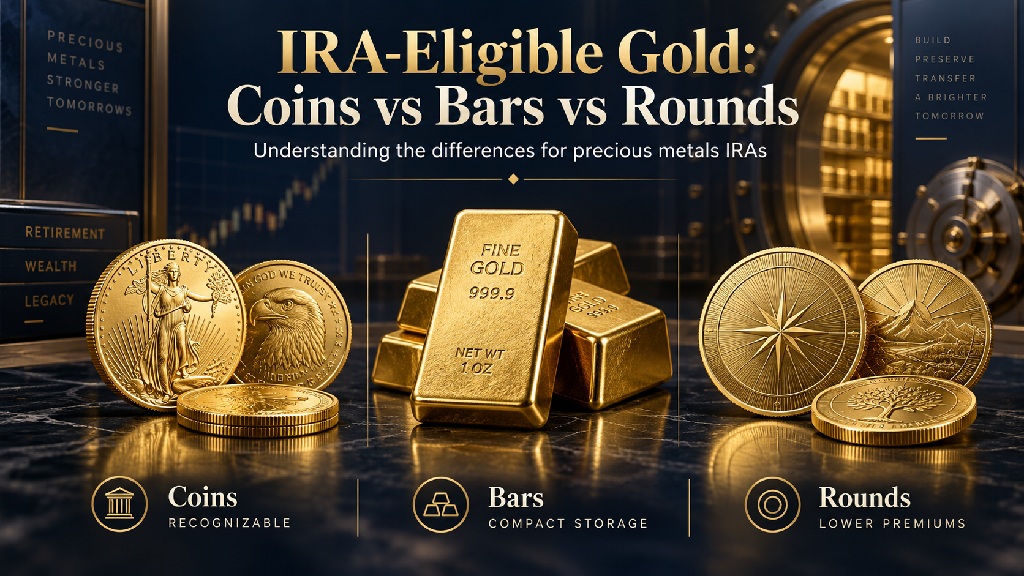
TL;DR: Coins, bars, and rounds can all qualify for a self-directed gold IRA, because eligibility runs through federal tax law rather than the product’s shape. A coin can qualify by name under Internal Revenue Code section 408(m)(3)(A), while a bar or round qualifies only by meeting a minimum fineness and coming from an accredited refiner under section 408(m)(3)(B). Once a product clears that bar, the choice among coin, bar, and round becomes a market question of premium, liquidity, and divisibility, not a legal one. For the full list of eligible products, see IRA-approved precious metals. For the general, non-IRA case for bars versus coins, see gold bars versus gold coins.
Eligibility Runs Through Two Statutory Pathways, Not the Product Shape
Gold clears a self-directed IRA through one of two pathways written into Internal Revenue Code section 408(m)(3), and which pathway applies depends on the product, not on how much someone paid for it.
The first pathway, section 408(m)(3)(A), names specific coins directly, including certain gold, silver, platinum, and state-issued coins described in Title 31 of the U.S. Code. A coin on that list qualifies because Congress named it, regardless of its exact purity. The second pathway, section 408(m)(3)(B), covers bullion of any of the four IRA-eligible metals once it meets the minimum fineness that a regulated futures exchange requires for delivery, and once it sits in the physical possession of the IRA’s trustee. For gold, that fineness floor is .995.
Bars and rounds have no equivalent to the named-coin list. They qualify only through the bullion pathway, which means fineness and custody carry the entire weight of the eligibility test. A coin can, in rare cases, ride the named exception even below .995 fine. A bar or round cannot. That asymmetry is the reason the format question inside an IRA is not really “is gold eligible,” which nearly every mainstream product answers yes to, but “does this specific coin, bar, or round clear the test that applies to its category.” The full roster of eligible coins, bars, and their exact fineness figures is covered separately at IRA-approved precious metals. For a wider view of how physical gold fits alongside the other routes into the asset, see investing in gold.
Proof Status Does Not Change the Eligibility Test
A proof coin, struck with a mirrored finish and sold at a premium over a standard bullion coin, is eligible on the same terms as its bullion counterpart, provided it meets the statutory test and is held by the trustee.
The U.S. Mint issues proof versions of the American Eagle line alongside its standard bullion strikes, and the proof designation itself has no bearing on the section 408(m)(3) analysis. What matters is whether the coin is one of the products named in the statute or meets the fineness bar, not its finish or its packaging.
The caution runs the other direction. A collectible or semi-numismatic coin marketed chiefly on rarity or grade, rather than on its metal content, should be treated carefully even if a seller calls it IRA-eligible. Eligibility has to rest on the statute itself, not on a grading label or a claim of scarcity. A buyer who is unsure whether a specific proof or graded product qualifies is better served checking the product against the named-coin list or the fineness test directly than trusting a dealer’s eligibility claim at face value.
Bars and Rounds Need an Accredited Refiner, Not Just a Fineness Number
Meeting the .995 fineness threshold is necessary for a gold bar or round to qualify, but it is not sufficient. The bar or round also has to come from an accredited refiner or a national mint.
Section 408(m)(3)(B) ties eligibility to the fineness a regulated futures exchange requires for delivery, and in practice that means the bar has to be a brand the exchange itself recognizes. The CME Group COMEX rulebook states plainly that gold delivered against its contract must assay to a minimum of 995 fine and must be a brand the exchange has approved, and COMEX has aligned its approved list with refiners on the London Bullion Market Association Good Delivery list, which itself sets a minimum acceptable gold fineness of 995.0 parts per thousand.
That accreditation requirement is why an unbranded or off-market bar, even one that assays correctly, is a poor candidate for an IRA. A custodian has no practical way to verify fineness and provenance on a bar from a refiner outside the recognized list, so the accreditation standard functions as the working proxy for the fineness test in the real world. A buyer evaluating a specific bar or round should confirm the refiner appears on a recognized Good Delivery or exchange-approved list before assuming the fineness number alone settles the question.
A Round Is a Privately Minted Disc, Not a Coin With Legal Status
A round looks like a coin but carries no face value and is not legal tender anywhere, because it is struck by a private refiner or mint rather than issued by a sovereign government.
That distinction matters for the eligibility analysis. A round can never qualify through the named-coin pathway in section 408(m)(3)(A), because that pathway only reaches coins described in specific Title 31 provisions tied to sovereign issuance. A round’s only route into an IRA is the same bullion pathway that applies to bars, meaning it has to meet the fineness floor for its metal, gold at .995, silver at .999, platinum and palladium at .9995, and come from an accredited refiner.
In practice, a round sits closer to a bar than to a coin in how a custodian treats it. The private-mint origin is not a defect. It simply means a round’s eligibility rests entirely on fineness and refiner accreditation, with no fallback to a named-product exception if either test is not met.
The Choice Among Coin, Bar, and Round Is a Market Question, Not a Legal One
Once a coin, bar, and round each clear the eligibility test for their category, the decision among them turns on premium over spot price, liquidity, and divisibility, all of which are market observations rather than legal distinctions.
Sovereign-minted coins typically carry the highest premium over spot of the three formats, reflecting mint costs and the brand recognition a national issuer carries, and that same recognition tends to make coins the easiest format to resell at a fair price. Large bars sit at the other end. They carry the lowest premium per ounce, because less of the cost goes toward striking and packaging relative to the metal content, but a large bar is a single, indivisible unit, which limits how a holder can sell or distribute it in pieces.
Rounds generally price between coins and bars, and their recognition and resale liquidity tend to run somewhat below a sovereign coin’s, since a round carries a private refiner’s mark rather than a national mint’s. None of this changes what is eligible for an IRA. It changes what a holder gives up in cost or flexibility for the format chosen, and that tradeoff belongs in the same conversation as the general, non-IRA comparison covered at gold bars versus gold coins.
Fractional Coins Add Divisibility When a Distribution Needs to Be Split
A fractional coin, meaning a 1/10, 1/4, or 1/2 ounce denomination rather than a full ounce, carries a higher premium per ounce than its full-size counterpart, and the tradeoff buys divisibility rather than a lower cost.
Inside an IRA, that divisibility has a specific use. A required distribution or a partial in-kind distribution taken later in retirement is easier to size against a stack of fractional coins than against a single one-ounce coin or a bar, because the smaller units let a custodian match a distribution amount without forcing the sale or transfer of more metal than the distribution requires.
That is a planning consideration, not an eligibility one. A fractional coin qualifies under the same named-coin or fineness test as its full-size version, and holding a mix of sizes is a choice about how a distribution will eventually be taken, made well before the distribution itself is due. Always weigh format choices like this against your own plan, and consult your own financial and tax professionals before acting on them.
FAQ
Are gold bars IRA-eligible?
Yes, provided the bar meets the .995 minimum fineness required under Internal Revenue Code section 408(m)(3)(B) and comes from an accredited refiner or a recognized Good Delivery brand, and provided it is held by the IRA’s trustee rather than the account owner.
Are proof coins IRA-eligible?
Yes. A proof coin is eligible on the same terms as its standard bullion version, as long as it is a coin named in the statute or meets the applicable fineness test. The proof finish itself does not change the analysis.
What is a gold round, and is it different from a coin?
A round is a disc struck by a private refiner or mint that resembles a coin but carries no face value and is not legal tender. It qualifies for an IRA only through the bullion fineness pathway, never through the named-coin exception, since that exception applies only to coins issued under specific government authority.
Do rounds cost less than coins?
Generally yes, rounds tend to carry a lower premium over spot than sovereign coins, though usually more than large bars. That is a market observation about typical pricing, not a fixed rule, and premiums shift with supply, demand, and the specific refiner.
Why would an IRA hold fractional coins instead of one-ounce coins?
Fractional coins cost more per ounce but divide more finely, which makes them useful for sizing a required distribution or a partial in-kind distribution without moving more metal than the distribution calls for.
This article is educational and does not evaluate or recommend a specific dealer, custodian, or depository. Eligibility rules described here reflect Internal Revenue Code section 408(m)(3) and the CME Group and London Bullion Market Association standards referenced above, current as of August 2026. Confirm the eligibility of a specific product with the IRA custodian before purchase, and consult a tax professional about how a distribution of physical metal applies to a specific account.