
IRA-Approved Precious Metals: The Complete Eligibility List
TL;DR: A precious metal qualifies for a self-directed IRA through one of two paths written into IRC § 408(m)(3), a named-coin exception that covers specific U.S. and state-issued coins regardless of exact purity, or a minimum-fineness bullion test, gold at .995, silver at .999, platinum and palladium at .9995, for everything else. Either way, the metal has to sit with an IRS-approved trustee rather than the account owner. This page maps every product that clears one of those two tests, and the ones that fail it despite looking similar on a dealer’s shelf. It sits alongside the site’s broader guide to investing in gold, which covers the full range of routes into the asset class beyond the retirement-account rules below.
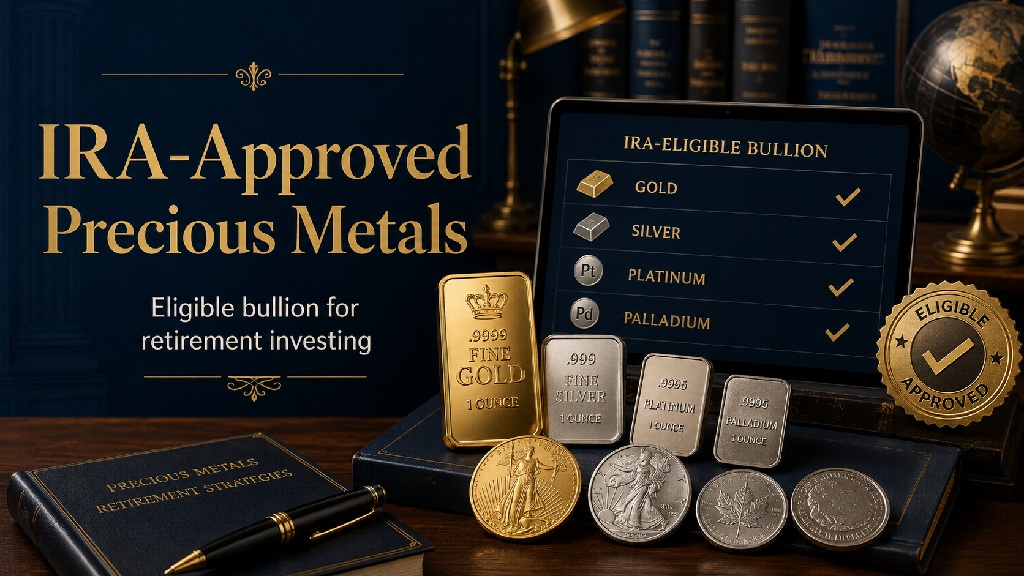
What Makes a Precious Metal IRA-Eligible
A precious metal qualifies for a self-directed IRA only if it clears one of two statutory tests written into IRC § 408(m)(3), a named-coin exception for specific coins or a minimum-fineness bullion standard for everything else, with the metal held by an approved trustee in both cases.
Section 408(m) of the tax code starts from a broad default: an IRA’s purchase of a “collectible,” a term defined to include any metal or gem, counts as a taxable distribution to the owner. What follows in Section 408(m)(3) is a pair of narrow carve-outs, and the entire eligibility question for a given product comes down to which carve-out, if either, it fits.
One carve-out runs through Section 408(m)(3)(A), which lists specific coins by statute: a gold coin under 31 U.S.C. § 5112(a)(7) through (10), a silver coin under § 5112(e), a platinum coin under § 5112(k), or a coin issued by any state. Membership on this list, not fineness, is what makes a coin eligible here.
The second path is the bullion-fineness test. Section 408(m)(3)(B) exempts gold, silver, platinum, or palladium bullion that meets the minimum fineness a futures exchange requires for delivery against a regulated contract, provided the bullion is in the physical possession of a trustee. That fineness bar comes from the contract markets the Commodity Exchange Act regulates, not from the tax code itself, which is why the numbers below trace back to CME and COMEX rulebooks rather than to the IRS.
One asymmetry matters for palladium buyers specifically. Palladium appears only in the bullion-fineness path, § 408(m)(3)(B). There is no named palladium coin under § 408(m)(3)(A), so every eligible palladium product, coin or bar, has to clear the .9995 fineness bar on its own. Platinum and palladium bullion eligibility was added by the Taxpayer Relief Act of 1997, which broadened the menu of permitted IRA metals starting in 1998.
Both paths share one non-negotiable condition: the metal has to be held by an approved trustee, a bank or an IRS-approved nonbank custodian, not by the account owner. The U.S. Tax Court enforced that condition directly in McNulty v. Commissioner, 157 T.C. No. 10 (2021), holding that an IRA owner who took physical possession of IRA-owned coins at home received a taxable distribution in the year she took them. Eligibility and custody are two separate requirements, and a product that passes the fineness or named-coin test can still trigger a distribution if it ends up in a home safe rather than an approved depository.
Gold Products That Qualify
The American Gold Eagle is IRA-eligible under the named-coin exception despite falling short of the .995 fineness bar, while every other IRA gold product on the market, from the Gold Buffalo to accredited bars, qualifies by meeting or exceeding that .995 standard directly.
The CME Group COMEX rulebook sets gold’s deliverable minimum fineness at .995, and that number is the bar every gold product has to clear unless it qualifies through the named-coin path instead.
- American Gold Eagle, 22-karat, .9167 fine, issued in 1 oz ($50 face), 1/2 oz ($25), 1/4 oz ($10), and 1/10 oz ($5) sizes. The U.S. Mint describes the coin’s alloy as 91.67 percent gold, 3 percent silver, and 5.33 percent copper, with each coin still containing its full stated weight of pure gold. It qualifies through the named-coin exception, § 408(m)(3)(A)(i), not through the .995 fineness rule, because it falls well below that threshold.
- American Gold Buffalo, .9999 fine, 24-karat, $50 face, 1 oz. The U.S. Mint calls it the first .9999 fine 24-karat gold coin the Mint ever struck. It qualifies on fineness alone.
- Austrian Gold Philharmonic, 999.9 fine, 1 oz (100 EUR face) plus fractional sizes, struck by the Austrian Mint. Qualifies on fineness.
- Australian Gold Kangaroo (Nugget), .9999 fine, 24-karat, multiple sizes, struck by the Perth Mint. Qualifies on fineness.
- Canadian Gold Maple Leaf, widely reported at .9999 fine, 1 oz ($50 CAD face) plus fractional sizes, struck by the Royal Canadian Mint. Qualifies on fineness.
- Gold bars, eligible at .995 fine or higher when produced by an accredited refiner meeting London Bullion Market Association Good Delivery standards or an exchange-approved brand list. Confirm refiner accreditation directly rather than relying on a dealer’s eligibility claim alone.
Silver Products That Qualify
Every IRA-eligible silver product has to meet a .999 minimum fineness under the COMEX deliverable standard, and the American Silver Eagle clears that bar while also carrying the separate named-coin exception that covers it independently.
- American Silver Eagle, .999 fine, 1 troy oz, $1 face, inscribed “1 OZ. FINE SILVER.” It qualifies two ways at once, through the named-coin exception, § 408(m)(3)(A)(ii), because it is a silver coin described in 31 U.S.C. § 5112(e), and through the .999 fineness test independently.
- Canadian Silver Maple Leaf, widely reported at .9999 fine, 1 oz, Royal Canadian Mint. Qualifies on fineness.
- Austrian Silver Philharmonic, .999 fine, 1 oz (1.50 EUR face), Austrian Mint, introduced in 2008. Qualifies on fineness.
- Australian Silver Kangaroo and Kookaburra, reported at .9999 fine, struck by the Perth Mint. Qualifies on fineness.
- Silver bars and rounds, eligible at .999 fine or higher from an accredited refiner or national mint.
For a closer look at how coin premiums compare, see what are the best silver coins in an IRA.
Platinum Products That Qualify
Platinum is the one metal that carries eligibility through both statutory paths at once, since American, Canadian, and Austrian platinum coins each clear the .9995 fineness bar and are also named coins under § 408(m)(3)(A)(iii).
- American Platinum Eagle, .9995 fine, 1 oz ($100 face), first released in 1997. The U.S. Mint lists the coin’s composition as 99.95 percent platinum. It qualifies both through the named-coin exception, since it is a platinum coin described in 31 U.S.C. § 5112(k), and through the .9995 fineness test.
- Canadian Platinum Maple Leaf, reported at .9995 fine, 1 oz ($50 CAD face), Royal Canadian Mint, first issued in 1988. Qualifies on fineness.
- Austrian Platinum Philharmonic, 999.5 fine, 1 oz (100 EUR face), Austrian Mint, issued since 2016. Qualifies on fineness.
- Platinum bars, eligible at .9995 fine or higher from an accredited refiner.
Palladium Products That Qualify
Palladium has no named-coin exception under the statute, so every eligible palladium product, whether a government-minted coin or a refiner bar, has to independently clear the .9995 fineness bar set by the NYMEX deliverable standard.
- American Palladium Eagle, .9995 fine, 1 oz ($25 face), first released in 2017 under the American Eagle Palladium Bullion Coin Act of 2010. The reverse carries the inscription “1 OZ. Pd .9995 FINE.” It qualifies solely through the bullion-fineness path, § 408(m)(3)(B), because palladium coins are not named in § 408(m)(3)(A).
- Canadian Palladium Maple Leaf, reported at .9995 fine, 1 oz ($50 CAD face), Royal Canadian Mint, first issued in November 2005 as the first palladium coin struck by a government mint. Qualifies on fineness.
- Palladium bars, eligible at .9995 fine or higher from an accredited refiner.
What Does Not Qualify
A product can look identical in weight and karat to an eligible coin and still fail the IRA test entirely, and the South African Krugerrand is the clearest example of a widely traded coin that several dealer sites incorrectly describe as eligible.
- South African Krugerrand, 22-karat, .9167 fine. This coin misses on both fronts, its purity sits under the .995 bullion floor, and Congress never listed it among the coins named in § 408(m)(3)(A). Buyers should be skeptical of any dealer page that calls it IRA-eligible. The claim shows up often, and it is simply wrong.
- Pre-1933 U.S. gold coins, such as the $20 Saint-Gaudens Double Eagle, struck at .900 fine, 90 percent gold and 10 percent copper, between 1907 and 1933. Not eligible. They sit well below the .995 bullion bar and are generally treated as numismatic collectibles rather than IRA bullion.
- British gold sovereign, minted at roughly the same 22-karat fineness as the Krugerrand. Not eligible, for the same two reasons: it fails the fineness test and it is not among the statute’s named coins.
- Rare, graded, or “slabbed” numismatic coins generally, excluded as collectibles under § 408(m)(1) and (2) regardless of metal content, because their value comes from rarity and grade rather than bullion weight. Eligibility rests on the statute, not on a coin’s collector premium.
Coins vs Bars vs Rounds: Where the Nuances Show Up
Proof coins, bars, and privately minted rounds can all be IRA-eligible, but each has to independently clear the same fineness and custody tests, and a high premium or numismatic marketing claim does not substitute for meeting the statute.
Proof versions of the American Eagle series are eligible on the same terms as their bullion counterparts, provided the coin still meets the applicable statutory test and sits with the trustee. The caution runs the other way: a collectible or semi-numismatic proof issue sold chiefly on rarity or grade should be treated skeptically, because eligibility has to rest on the coin type meeting the statute, not on the premium a dealer is charging for it.
Bars and rounds face the same .995 to .9995 fineness bar, metal by metal, but they add one more condition. The bullion has to come from an accredited refiner, assayer, or manufacturer, or from a national government mint. The LBMA Good Delivery standard sets a minimum acceptable fineness of 995.0 parts per thousand for gold, and COMEX gold delivery similarly requires bars from a brand the exchange has approved, a requirement that has aligned with the LBMA’s own approved-brand list since 2020. A bar or coin that cannot show refiner or mint accreditation is not IRA-eligible regardless of its stamped fineness.
A round is a bullion disc struck by a private mint rather than a government one. It carries no denomination and does not function as legal tender anywhere. Treat a round exactly like a bar for eligibility purposes, it needs the accredited-refiner pedigree and the correct fineness, and nothing beyond that changes the analysis.
Frequently Asked Questions
These six questions cover the eligibility edge cases that trip up the most buyers, from the fineness gap that makes the American Eagle a special case to the custody rule that determines whether an otherwise-eligible coin still triggers a tax bill.
Is the Krugerrand IRA-eligible?
No. Its .9167 fineness sits under the .995 bullion floor, and § 408(m)(3)(A) does not list it among the named coins. Both statutory doors are closed to it.
Does the American Gold Eagle meet the .995 fineness standard?
No, its .9167 fineness falls well short of the .995 mark. The coin still qualifies, because § 408(m)(3)(A)(i) names it directly as one of the gold coins described in 31 U.S.C. § 5112(a). Purity is irrelevant once a coin is on that list.
Can IRA-owned precious metal be stored at home?
No. Both statutory paths require the metal to be held by an approved trustee, and the Tax Court’s McNulty decision confirmed that an owner taking physical possession, even through a self-directed IRA’s own LLC, creates a taxable distribution.
Are proof coins IRA-eligible?
Proof versions of the American Eagle series qualify on the same terms as the bullion version, provided the coin meets the applicable statutory test and is held by the trustee. Collectible or semi-numismatic proof issues sold mainly on rarity should not be assumed eligible.
What is the minimum fineness for platinum and palladium?
Both metals carry a .9995 minimum fineness under the COMEX and NYMEX deliverable standard. Platinum coins also have a named-coin exception under § 408(m)(3)(A)(iii). Palladium coins do not, so every eligible palladium product has to meet .9995 on its own.
Are gold bars IRA-eligible?
Yes, at .995 fine or higher, provided the bar comes from an accredited refiner or a brand approved for delivery on an exchange like COMEX. A bar without that accreditation does not qualify regardless of its stamped purity.
This article is for general information only. It is not tax, legal, or investment advice. Talk with a qualified tax professional or financial advisor before making any decision about the precious metals held inside a retirement account.