Best Silver Coins for an IRA: The IRA-Eligible List
TL;DR: Only two legal pathways make a silver product IRA eligible under Internal Revenue Code Section 408(m)(3). The American Silver Eagle qualifies through the named-coin exception in 408(m)(3)(A)(ii), regardless of its measured fineness. Every other silver coin, bar, or round, including the Canadian Silver Maple Leaf and the Austrian Silver Philharmonic, must clear the .999 bullion-fineness bar in 408(m)(3)(B) and sit in the physical custody of an IRS-approved trustee.

Which Silver Coins Are IRA Eligible
One silver coin, the American Silver Eagle, is IRA eligible because the tax code names it directly. Every other silver coin, bar, or round qualifies only by meeting a .999 minimum fineness.
The full mechanics of the underlying statute, IRC Section 408(m)(3), including the two-pathway structure it sets for every eligible metal, are covered in the site’s general guide to precious metals IRA eligibility. For silver specifically, the practical split is this: the American Silver Eagle qualifies under the 408(m)(3)(A)(ii) named-coin exception regardless of its exact purity, while the Canadian Silver Maple Leaf, the Austrian Silver Philharmonic, and the Australian Silver Kangaroo and Kookaburra all qualify by clearing the .999 minimum fineness that CME Group, which operates COMEX, sets for deliverable-grade silver in its own physical delivery rules, the figure retail guides shorten to “.999 fine.”
American Silver Eagle: The Named-Coin Exception
 The American Silver Eagle is the only silver coin named directly in the tax code, struck from one troy ounce of .999 fine silver with a $1 face value and issued by the U.S. Mint. Its eligibility traces to 31 U.S.C. Section 5112(e), the statute Congress cross-referenced when it wrote the 408(m)(3)(A)(ii) named-coin exception. That statute specifies the coin at 40.6 millimeters in diameter and 31.103 grams, carrying the inscription “1 Oz. Fine Silver.”
Because the coin is named directly rather than qualified by a fineness test, both the standard bullion strike and the proof version are IRA eligible, provided the proof coin meets the same statutory test and is held by the trustee rather than the account owner. That is unusual. Most proof and collectible coin issues are treated as numismatic collectibles and excluded, but the Silver Eagle’s named-coin status covers both finishes.
Canadian Silver Maple Leaf
 The Canadian Silver Maple Leaf qualifies through the bullion-fineness pathway, not a named-coin exception, at a purity of .9999, one troy ounce, produced by the Royal Canadian Mint. Because it is not one of the coins listed under 31 U.S.C. Section 5112, its eligibility rests entirely on clearing the .999 minimum that 408(m)(3)(B) sets by reference to the COMEX deliverable standard, and on being held by an IRS-approved custodian rather than the account owner.
Austrian Silver Philharmonic
Minted by the Austrian Mint since 2008, the Silver Philharmonic is .999 fine, weighs one troy ounce, and carries a face value of 1.50 euro, qualifying under the same bullion-fineness route as the Maple Leaf. The Austrian Mint states the coin’s fineness directly on its own product pages, which makes it one of the more straightforwardly documented non-U.S. entries on the eligible list. Like the Maple Leaf, its eligibility depends on clearing .999 and sitting in trustee custody, not on any named-coin status.
Australian Silver Kangaroo and Kookaburra
The Perth Mint’s Silver Kangaroo and Silver Kookaburra coins are marketed at .9999 fine and qualify through the bullion pathway if that fineness holds and the coin sits in trustee custody. Both are struck in Australia by the Perth Mint and follow the same eligibility logic as the Canadian and Austrian entries. No named-coin exception applies to either, so eligibility rests on the fineness test alone.
Silver Bars and Rounds
Silver bars and rounds are IRA eligible on the same .999 fineness test as coins, provided an accredited refiner or a national mint produced them and a qualified trustee holds them. The London Bullion Market Association sets the Good Delivery standard that underlies most refiner accreditation, and COMEX requires deliverable metal to carry a brand the exchange itself approves, the practical meaning of the statute’s reference to a contract market’s delivery standard.
A round is not a coin. It is a privately minted disc that resembles one but carries no legal-tender face value and no government backing. That distinction does not affect IRA eligibility. A round qualifies exactly like a bar, on fineness and refiner accreditation, not on whether it looks like currency.
What Does Not Qualify
Rare, graded, or numismatic silver coins are excluded from an IRA regardless of their silver content, because Section 408(m)(1) and (2) treat collectibles as a taxable distribution and eligibility depends on the statute, not on rarity or grade. A coin whose market value is driven mainly by scarcity or condition, rather than by its bullion weight, does not become eligible simply because it also contains a troy ounce of silver. The same logic applies to “slabbed” or third-party-graded coins carrying a high premium over spot. If a product’s eligibility claim rests on anything other than the named-coin exception or the .999 fineness test, that claim does not come from the statute.

Coins, Bars, and Rounds: Premium and Liquidity Tradeoffs
Sovereign coins like the Silver Eagle and Silver Maple Leaf tend to carry the widest recognition and the deepest resale market, bars carry the lowest premium per ounce but are less divisible, and rounds usually price between the two with somewhat lower brand recognition than a government-minted coin. None of this is a legal eligibility distinction. It is a market observation about how dealers price and how easily a holder can resell.
Fractional coin sizes add another tradeoff. A quarter-ounce or half-ounce coin carries a higher premium per ounce than a full one-ounce coin of the same design, because a mint’s striking and distribution costs do not scale down proportionally with weight. Inside an IRA, that higher cost can be worth paying if it lets an owner take a partial in-kind distribution later without breaking up a larger bar. Always weigh premium and divisibility against your own plan, and consult your own financial and tax professionals before choosing a size.
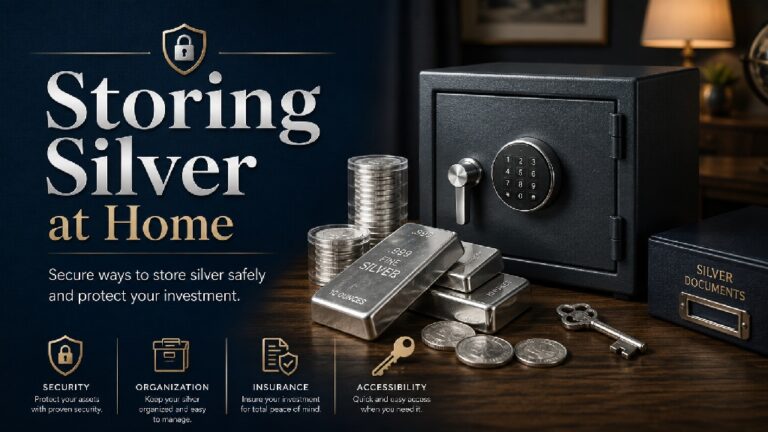
Custody Rules: Why IRA Silver Cannot Sit in a Home Safe
IRA silver must remain in the physical possession of a bank or an IRS-approved nonbank trustee, and the U.S. Tax Court has already ruled on what happens when it does not.
Section 408(a) requires the trustee to be a bank or an entity the IRS has approved as a nonbank custodian, and 408(m)(3)(B) repeats the requirement for bullion specifically, that eligible metal be in the physical possession of a trustee. In practice, that means an approved third-party depository holds the coins, not a safe at the owner’s house and not an IRA-owned LLC the owner personally controls.
The U.S. Tax Court tested that rule directly in McNulty v. Commissioner, 157 T.C. No. 10, decided November 18, 2021. Donna McNulty used a self-directed IRA to form a single-member LLC, directed it to buy American Eagle coins, and stored them in a home safe. The court held that her possession of the coins was a taxable distribution the moment she took them home, reasoning that an owner of a self-directed IRA “may not take actual and unfettered possession of the IRA assets.” The IRS determined she had received taxable distributions of $374,000 for 2015, tied to gold Eagle purchases, and $37,380 for 2016, tied to 2,000 one-ounce American Eagle silver coins, and the court sustained accuracy-related penalties on top of the tax. A home safe, even one owned through an LLC the account holder controls, does not satisfy the custody requirement, no matter which metal or coin sits inside it.
Frequently Asked Questions
Are proof American Silver Eagles allowed in an IRA?
Yes. Because the coin qualifies through the named-coin exception rather than the fineness test, both the standard bullion strike and the proof version are eligible, provided the proof coin meets the statutory test and is held by the trustee rather than the account owner.
Can IRA silver coins be stored at home?
No. The U.S. Tax Court held in McNulty v. Commissioner that an IRA owner who takes physical possession of coins, even through a single-member LLC, has received a taxable distribution equal to their cost, plus potential accuracy-related penalties.
What is the minimum fineness for silver in an IRA?
.999, the deliverable-grade minimum CME Group sets for COMEX silver futures and the standard 408(m)(3)(B) incorporates by reference. The American Silver Eagle is exempt from this test because it qualifies through the named-coin exception instead, though it also happens to meet .999.
Does the Silver Eagle need to pass the .999 fineness rule to be IRA eligible?
No. Its eligibility comes from being named directly in 31 U.S.C. Section 5112(e), which 408(m)(3)(A)(ii) cross-references. The fineness test in 408(m)(3)(B) applies to every other silver product on this list.
What is the IRA contribution limit for 2026?
$7,500, with a $1,100 catch-up contribution for account holders age 50 and older, published in IRS Notice 2025-67. The 2025 limit was $7,000 with a $1,000 catch-up.
This page is educational information about IRA-eligible silver products under federal tax law. It is not financial, tax, or legal advice. Always weigh eligibility rules against your own retirement plan, and consult your own financial and tax professionals before buying silver inside an IRA.