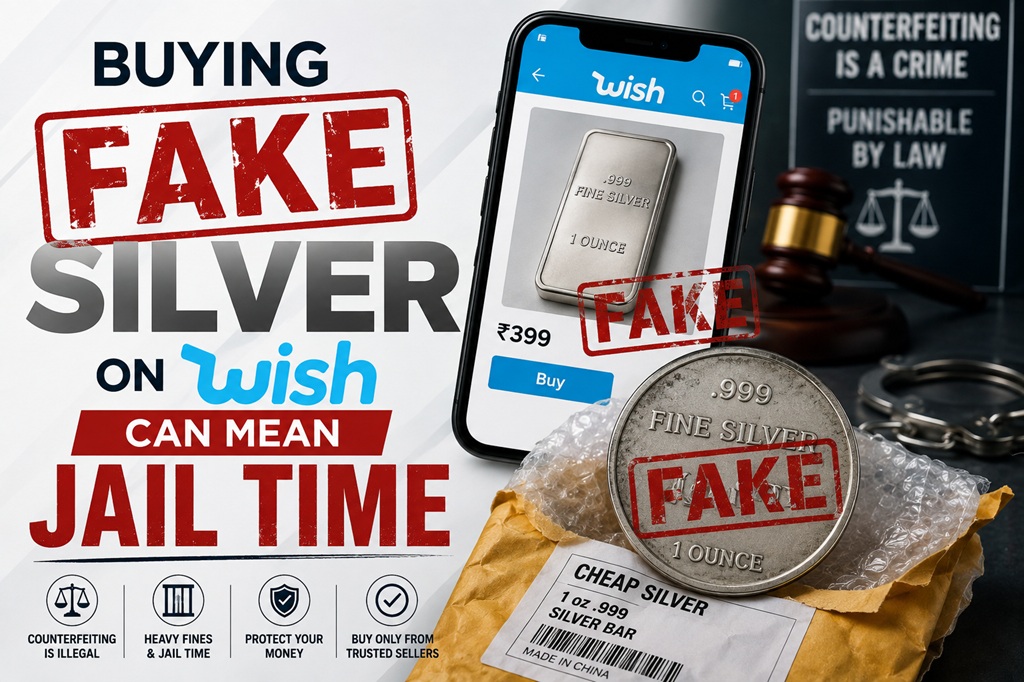
Buying Fake Silver on Wish Can Mean Jail Time
TL;DR: Knowingly buying, possessing, or reselling a counterfeit silver coin or bar is a federal crime under 18 U.S.C. §§ 485, 486, and 487, with penalties running up to 15 years in prison. Marketplaces such as Wish, AliExpress, and eBay carry silver colored bars and coins stamped with real refiner names, including Credit Suisse, Johnson Matthey, Scottsdale, and SilverTowne, priced far below what an ounce of actual silver can cost. Checking a listing’s price against the current spot price of silver is the fastest way to tell a bargain from a counterfeit.
Does Buying Fake Silver on Wish or AliExpress Break the Law?
Federal law makes it a crime to knowingly buy, sell, or possess a counterfeit coin or bar, not only to manufacture one, so a marketplace like Wish, AliExpress, or eBay provides no legal shelter for the buyer on the other end of the listing.
Cut-rate marketplaces have become a steady source of counterfeit silver bullion. Listings advertised as one ounce American Silver Eagles, or as bars carrying the stamped names of major refiners, turn up at prices no legitimate seller could sustain and still cover the cost of the metal. The seller’s intent matters most for a manufacturing charge, but a buyer does not need to have made anything to be exposed. Federal law reaches the purchase and possession side directly, provided the buyer knew, or had reason to know, the item was not genuine.
That knowledge element is where price becomes evidence rather than just a bargain. A buyer who pays two dollars for an item stamped as one troy ounce of .999 fine silver, when silver itself trades many multiples higher than that per ounce, has a hard time arguing later that the purchase looked legitimate at the time.
The Steal Test: How to Price-Check a Silver Listing Before You Buy
 A listing priced anywhere near, at, or below the value of the silver itself, for a coin or bar that would normally carry a real premium, is not a bargain. It is a warning sign that the product is not genuine.
Real silver is never free to mine, refine, mint, and ship, so a genuine one ounce coin or bar always costs more than the metal’s own spot value on any given day, whatever that value happens to be. Say silver is trading around $30 an ounce, purely as an illustration. A genuine one ounce American Silver Eagle would sell for a few dollars over that metal value, reflecting the cost of striking and distributing the coin, never at the metal value and never below it. A listing offering that same coin for $2 or $3 is asking a buyer to believe an ounce of silver, plus minting and distribution, is worth pocket change. That gap between the claimed product and its own melt value is the tell, and it holds no matter where the spot price actually sits on the day a buyer sees the listing.
Federal consumer protection messaging about counterfeit goods distills to a similar idea: an offer that looks too good to be true generally is exactly that. The math does not need to be exact to be useful. A buyer only needs to check a listed price against wherever silver happens to be trading that day, and recognize that a price sitting at or below the raw metal’s own value cannot be genuine.
Fake Bars Stamped With Real Refiner Names
Bars listed under the names Credit Suisse, Johnson Matthey, Scottsdale, and SilverTowne have shown up on discount marketplaces at prices that make clear they are not manufactured by, or licensed by, any of those companies.
Each of those names belongs to an actual, established refiner or mint with its own registered marks. A one ounce bar stamped with a refiner’s name and fineness, sold for a few dollars, cannot contain the fine silver it claims and cannot have been produced with that refiner’s permission. Using a company’s registered mark on a metal item without authorization is an unauthorized use of that trademark on its own, separate from whatever the item is actually made of. Buying and selling the item compounds the problem, because the counterfeit coin or bar statute at 18 U.S.C. § 485 does not require the item to imitate US currency specifically. It reaches any counterfeit gold or silver bar coined or stamped at a mint or assay office of the United States.
What 18 U.S.C. §§ 485, 486, and 487 Actually Say
Three federal statutes cover this conduct directly. Together they punish counterfeiting coins or bars, passing fake metal coins as money, and making or possessing the tools used to strike counterfeit coins, with prison terms running up to 15 years on the most serious charges.
18 U.S.C. § 485 covers coins or bars. Its operative text states:
“Whoever falsely makes, forges, or counterfeits any coin or bar in resemblance or similitude of any coin of a denomination higher than 5 cents or any gold or silver bar coined or stamped at any mint or assay office of the United States, or in resemblance or similitude of any foreign gold or silver coin current in the United States or in actual use and circulation as money within the United States; or
Whoever passes, utters, publishes, sells, possesses, or brings into the United States any false, forged, or counterfeit coin or bar, knowing the same to be false, forged, or counterfeit, with intent to defraud any body politic or corporate, or any person, or attempts the commission of any offense described in this paragraph, shall be fined under this title or imprisoned not more than fifteen years, or both.”
The statute reaches two separate acts. The first is making or forging the counterfeit item itself. The second, and the one that actually reaches a buyer, is knowingly passing, selling, possessing, or importing a counterfeit coin or bar with intent to defraud. Possessing a stack of fake Silver Eagles, alone, is not automatically a felony. Possessing them while trying to pass them off as real, sell them as real, or knowing full well what they are and intending to defraud someone with them, is what the statute targets.
18 U.S.C. § 486 covers uttering counterfeit coins of gold, silver, or other metal, meaning making, passing, or attempting to pass unauthorized metal coins intended for use as current money, whether or not they copy an existing design. That offense carries a fine and up to five years in prison, a lower ceiling than Section 485.
18 U.S.C. § 487 goes a step further back in the process and covers the dies, hubs, and molds used to strike counterfeit coins:
“Whoever, without lawful authority, makes any die, hub, or mold, or any part thereof, either of steel or plaster, or any other substance, in likeness or similitude, as to the design or the inscription thereon, of any die, hub, or mold designated for the coining or making of any of the genuine gold, silver, nickel, bronze, copper, or other coins coined at the mints of the United States; or
Whoever, without lawful authority, possesses any such die, hub, or mold, or any part thereof, or permits the same to be used for or in aid of the counterfeiting of any such coins of the United States, shall be fined under this title or imprisoned not more than fifteen years, or both.”
Section 487 is aimed mainly at manufacturers rather than retail buyers, but it establishes that Congress treats the entire counterfeiting supply chain, from the tooling to the finished coin, as a felony matter carrying the same fifteen year ceiling as Section 485.
The COPY-Stamp Rule for Replica Coins and Bars
Long standing federal law requires imitation numismatic items, meaning replicas made to resemble real coins or bars, to be permanently and visibly marked COPY, and a replica missing that mark can be treated as an illegal counterfeit regardless of what the listing description says.
A seller can write “replica,” “commemorative,” or “silver plated” in a product description as many times as they want. None of that substitutes for the physical requirement. If the item itself is not clearly and permanently marked in a way that would prevent an average buyer from mistaking it for the genuine article, the physical object is the problem, not the listing text. That distinction matters, because plenty of counterfeit silver circulating on discount marketplaces is described accurately as a “copy” in the title while the coin itself carries no such mark, which is where the legal exposure actually sits.
What Happens If You’re Caught With Counterfeit Silver
The legal risk scales with intent and quantity. A buyer holding one obviously fake bar faces a very different practical outcome than someone caught trying to pass counterfeit coins off as real or reselling them to someone else, but the statutory ceiling in either case runs into felony territory.
A single mismarked bar bought on a discount marketplace, sitting unused in a drawer, is unlikely to draw prosecutorial attention on its own. The exposure changes the moment intent to defraud enters the picture, whether that means reselling counterfeit coins as genuine, using them to pay a debt, or being found with a collection of them during an unrelated police encounter and being unable to account for how they were acquired. The federal statute does not require proof the buyer manufactured anything. It requires proof of knowledge and intent to defraud, and a rock bottom purchase price is one of the more straightforward ways prosecutors build that case.
Marketplaces generally prohibit counterfeit listings and rely on sellers and buyers to report them, but platform enforcement does not substitute for the criminal exposure sitting with an individual buyer. A takedown removes a listing. It does not undo a purchase already made.
How to Buy Silver Bullion Without the Legal or Financial Risk
The safest approach is to treat price as the first filter, buy sovereign coins or bars from an established bullion dealer, and walk away from any listing priced near or below the metal’s own spot value.
Sovereign coins such as the American Silver Eagle are minted by a national mint, carry a fineness the buyer does not have to independently verify, and rank among the most liquid, most recognizable forms of silver bullion, which makes them easy to price check against a live spot chart before buying. Bars and rounds from well known refiners trade almost as smoothly. Established dealers publish live buy and sell prices, so a buyer can see the premium charged in real time rather than guessing at it from a marketplace listing with no pricing transparency behind it.
A buyer who wants silver as an asset, rather than as a decorative object, consistently gets that with a legitimate coin priced at spot plus an honest premium. A two dollar bar priced to look like a deal is not an asset. It is, at best, a worthless souvenir, and at worst, evidence. Always weigh a purchase like this against your own plan, and consult your own financial and tax professionals if you are unsure whether something you already bought crosses a legal line.
Frequently Asked Questions
Is it illegal to own a fake silver coin?
Owning a counterfeit coin is not automatically a crime by itself. Federal law under 18 U.S.C. § 485 targets passing, selling, possessing, or importing a counterfeit coin or bar knowingly and with intent to defraud. Simple possession, without any intent to pass it off as genuine or defraud anyone, sits in a gray area, but it is not a position anyone should want to test.
What is the penalty for buying counterfeit silver coins or bars?
Under 18 U.S.C. § 485, a conviction carries a fine and up to 15 years in prison. Under 18 U.S.C. § 486, the ceiling for uttering counterfeit metal coins is up to five years. Under 18 U.S.C. § 487, making or possessing the dies used to strike counterfeit coins also carries up to 15 years.
How can I tell if a silver coin or bar is fake before buying it?
Compare the asking price to wherever silver is trading that day. A one ounce silver coin or bar priced at or near the metal’s own spot value, or below it, cannot be genuine, because legitimate silver coins and bars always carry a premium over spot to cover minting, refining, and dealer costs. The exact premium moves with the market, but a price sitting at or under the raw metal value on any given day is a reliable sign of a counterfeit.
Are all replica silver coins illegal to sell or own?
No. A replica that is permanently and visibly marked COPY, and that cannot reasonably be mistaken for the genuine coin, is legal to sell and own. The problem is a replica sold without that mark, or with a mark that is not clear or permanent.

Does eBay or AliExpress allow counterfeit silver listings?
No major marketplace’s stated policies permit counterfeit bullion listings, and each provides a way to report them. Enforcement depends on users flagging listings and does not catch every violation, so a listing’s presence on a marketplace is not evidence that the item is legal or genuine.
Disclosure: This is an independent editorial site. It may earn a commission when a reader uses a partner link, and that relationship has no bearing on the reporting above.