Storing Silver at Home: A Practical Guide
TL;DR: Storing personally owned, non-IRA silver at home is legal, and for many investors it is a reasonable way to keep part of a metals position within direct reach. The practical work is in the details: a safe with an independent burglary and fire rating, anchoring that keeps the safe from simply being carried off, a homeowner’s or renter’s insurance rider sized to the metal’s actual value, and discretion about who knows it is there. Silver purchased inside a retirement account is a separate legal question the IRS and the U.S. Tax Court have already settled against home storage, and that boundary is addressed once, briefly, near the end of this guide.
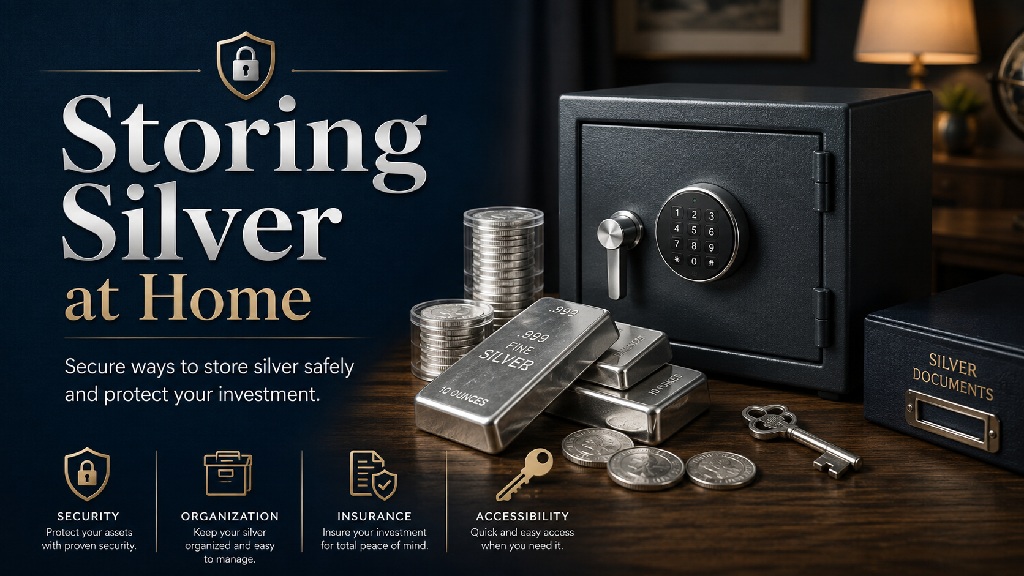
Storing silver at home is legal for anyone who owns the metal personally, outside a retirement account, and paid for it with after-tax money. There is no trustee requirement, no custodian, and no federal filing tied to where a private individual keeps coins or bars bought outright. What matters is not whether home storage is allowed but whether it is done well. This guide covers the practical side of that decision: what actually makes a safe resistant to a break-in or a house fire, how to insure silver a standard homeowner’s policy will not fully cover, how much to tell other people, and why splitting a holding across more than one location changes the risk picture rather than just the logistics.
Why Some Investors Keep Silver at Home
Keeping silver at home trades the oversight and layered security of a professional vault for direct, immediate access to the metal, and that trade only makes sense for the portion of a holding an investor is prepared to secure and insure personally.
The appeal is straightforward. Metal in a home safe can be reached in minutes, sold, gifted, or used as a private store of value without a phone call to a custodian or a shipping delay. For investors who see part of their silver position as a hedge against disruption rather than a purely financial holding, that immediacy is the entire point. It is also the reason the practice does not scale cleanly. A few hundred ounces of silver stored well is manageable. A position large enough to matter financially concentrates real value behind a single door in a single building, and the security and insurance work has to match that concentration rather than trail behind it. Investors who hold meaningful weight in silver often treat home storage as one piece of a larger plan rather than the whole plan, a point this guide returns to below.
Choosing a Safe: Burglary and Fire Ratings That Matter
A safe worth keeping silver in carries two separate, independently tested ratings, one for how long it resists forced entry and one for how long its interior stays cool enough to protect contents in a fire, and a container marketed only as heavy or fireproof without either rating should not be trusted with meaningful value.
Burglary resistance and fire resistance are tested differently and rated differently, and a safe can be strong on one axis while weak on the other. Underwriters Laboratories tests burglary-resistant safes against standardized attacks with hand tools, power tools, or torches and assigns ratings such as TL-15 or TL-30, where the number denotes the minutes the safe withstood a qualified attacker during testing. A safe with no independent burglary rating, however thick its steel looks, has not been tested against a real attempt and should be assumed to fail faster than its appearance suggests. Fire resistance is a separate test entirely, commonly expressed as a length of time, an hour is a typical benchmark, that the interior stays below the temperature at which paper and most documents char, while the exterior is exposed to a sustained high furnace temperature. A safe built for burglary resistance is not automatically fire resistant, and the reverse is also true, which is why a container bought for one purpose sometimes fails at the other during an actual event. For silver, weight and size work in the buyer’s favor compared with paper records or jewelry, since a heavier, properly rated unit is harder to remove quickly and cheaper per pound to build well than the equivalent protection for a smaller, higher-value item.

Bolting, Placement and Concealment
A safe that is not bolted to the floor or into wall framing is a portable box, and its ratings stop mattering the moment an intruder can carry it out and open it somewhere else at leisure.
Anchoring is not optional for a safe meant to hold real value. A unit bolted through its base into a concrete slab, or lagged into wall studs behind a fixed panel, forces an attacker to defeat it on site, which is exactly what the burglary rating was tested against. A safe sitting loose on a closet floor, no matter how heavy, can simply be wheeled out on a hand truck and worked on elsewhere without time pressure. Placement matters almost as much as anchoring. Security consultants commonly note that a primary bedroom closet or nightstand is the first place an intruder searches, since it is where most homeowners keep valuables, so a safe placed there gets less benefit from its rating than one placed somewhere less obvious, such as a utility area, a basement, or a built-in location behind a false wall. Concealment is a genuine layer of defense in its own right. A safe that does not read as a safe from across the room, and a home that gives no outward sign a safe exists at all, is harder to target in the first place than one with a visible steel door announcing what is behind it.
Insuring Silver Kept at Home
Most standard homeowner’s and renter’s policies cap coverage for precious metals and similar valuables well below what a meaningful silver holding is worth, so protecting it requires a scheduled personal property rider or a separate valuable-items policy rather than the base policy alone.
A standard homeowner’s or renter’s policy is built for ordinary household contents, and most carriers apply a modest sub-limit to categories like precious metals, coins, and jewelry regardless of the policy’s overall coverage amount. The Insurance Information Institute describes scheduled personal property, sometimes sold as a valuable-items floater, as the standard way to cover items whose value exceeds a policy’s built-in category limits, and silver held for investment purposes falls squarely into that category. Scheduling silver typically means documenting it with purchase receipts, dealer invoices, or a professional appraisal, and some insurers ask whether the metal is kept in a rated safe before setting a premium or a payout condition. Renters need the equivalent step under a renter’s policy, since the underlying gap, a low built-in sub-limit for precious metals, is the same regardless of whether the property is owned or leased. Skipping this step is the most common way a home-storage plan fails at the moment it matters most, when a loss occurs and the payout turns out to be a fraction of what was actually lost.
Discretion: Limiting Who Knows
 The simplest and most effective home-storage practice is also the least technical one: keep the fact that silver is stored in the home, and roughly how much, known to as few people as possible.
A well-rated, well-anchored, fully insured safe is still a target if enough people know it exists and holds value. Avoiding photos or posts about a metals purchase, being careful discussing holdings with contractors, repair technicians, or new acquaintances, and limiting how many friends or extended family members know the details all reduce the pool of people who could pass that information along, intentionally or not. This does not mean total secrecy is realistic or even desirable. At least one trusted person, typically a spouse or the person handling an estate, should know the holding exists and how to access it, since a silver position no one else can find after an owner’s death or incapacity defeats its own purpose. The goal is a short, deliberate list of people who know, not zero and not everyone.
Splitting Storage Across Multiple Locations
Dividing a silver holding between a home safe and a second location, such as a bank safe deposit box or a private vaulting service, limits the loss from any single event to a fraction of the total position rather than all of it.
A single location, however well secured, is a single point of failure. A house fire, a burglary, or a natural disaster affecting the home puts the entire home-stored portion at risk at once, which is the argument for splitting a larger holding rather than concentrating all of it behind one door. A bank safe deposit box adds a second, physically separate location and a different threat profile, though it is worth confirming in advance that a bank’s own insurance does not automatically cover the contents of a box, which is why box contents often still need their own scheduled coverage. Private vaulting services are another option for the portion of a holding an investor does not need to reach quickly, trading some of the immediacy that makes home storage appealing for professional-grade physical security and, typically, insurance built into the service. None of this requires an all-or-nothing choice. Keeping a working portion at home for accessibility and holding the rest somewhere else is a way to manage concentration risk in storage the same way diversification manages concentration risk in an investment portfolio.
Where the Line Falls With IRA-Owned Silver
Everything above applies only to silver an investor owns personally, outside a retirement account, and none of it applies to silver purchased through a self-directed IRA.
Silver held inside an IRA is governed by IRC § 408(m), which requires that qualifying bullion remain in the physical possession of a bank or an IRS-approved nonbank trustee, not the account owner. The U.S. Tax Court addressed an account owner’s home possession of IRA-owned coins directly in McNulty v. Commissioner, 157 T.C. No. 10 (2021), and held that taking personal possession of the coins was a taxable distribution, even though the coins had been purchased through a single-member LLC the IRA owned. That ruling, the statute behind it, and what it actually costs an account owner who tries to store IRA metal at home are covered in full on this site’s separate guide to home storage gold IRA rules, which is the place to go for that question. This page is about the silver an investor already owns outright.
FAQ
Is it legal to store silver at home? Yes, for silver an individual owns personally and outside a retirement account. There is no federal rule against a private individual keeping coins or bars in a home safe. The legal restriction discussed above applies only to silver purchased through a self-directed IRA.
What safe rating should I look for? Look for two separate, independently tested ratings rather than marketing language alone: a burglary rating from a recognized testing body such as Underwriters Laboratories, and a separate fire rating stating how long the interior stays protected at a sustained high temperature. A safe with only one of the two, or neither, offers less protection than its size or weight suggests.
Does homeowner’s insurance cover silver bars and coins? Usually only up to a modest built-in sub-limit for precious metals, which is often far below what a real holding is worth. Covering the full value typically requires scheduling the silver as a valuable-items rider on a homeowner’s or renter’s policy, which generally requires documentation such as receipts or an appraisal.
Can I store IRA-owned silver at home? No. Silver purchased through a self-directed IRA must remain with a qualified custodian at an approved depository. The U.S. Tax Court’s McNulty decision treated an IRA owner’s home possession of IRA-purchased coins as a taxable distribution. See this site’s dedicated guide to home storage gold IRA rules for the full legal picture.
Should I tell my insurer where the safe is and what rating it carries? Yes. Insurers writing a scheduled personal property rider commonly ask about the safe’s rating and sometimes condition coverage or pricing on it, so having that documentation ready when scheduling the silver avoids delays or disputes later.
This article is educational and does not constitute financial, insurance, or legal advice. Security and insurance needs vary by state, insurer, and the size of a given holding, so always weigh a home-storage plan against your own circumstances, and consult your own insurance and legal professionals before acting on it.